
I recently reached an incredible milestone – 500,000 books sold across 8 titles.
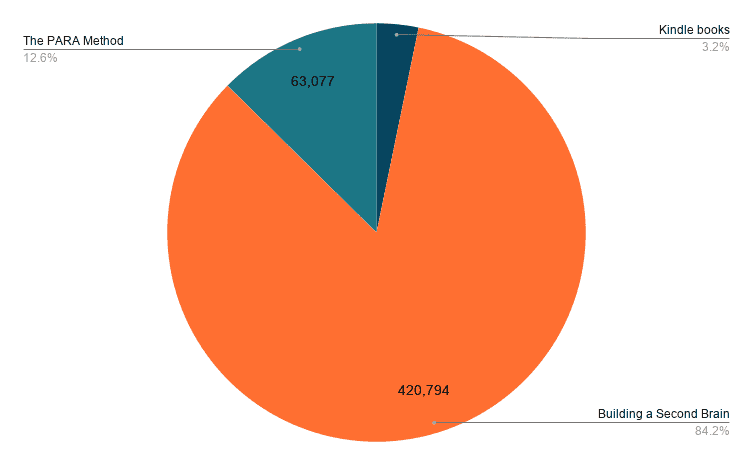
That includes 5 self-published Kindle ebooks, 1 co-authored book, and 2 traditionally published books, all released from 2017 to 2023. Here’s the breakdown of how those sales were distributed:
Almost every single thing I believed about bookwriting when I started turned out to be wrong. Let me share the most surprising, counterintuitive, and hard-won lessons I’ve gained from this journey.
A bestselling book is a terrible business on its own
My most successful book by far, Building a Second Brain (BASB), has achieved the highest heights of publishing success – over 400,000 copies sold.
You’d think such a breakout hit would have led to financial riches, but that wasn’t the case at first. Two years after release, in July 2024, I had yet to break even on the overall investment.
The reason is the enormous spending involved in creating the book and bringing it to market: $1.1 million in total. That included about $560,000 in team costs, $140,000 on a PR agency, $125,000 on an editor, $40,000 on design, $25,000 on the website, $15,000 on the launch party, and $12,000 for several writing retreats.
Those costs were offset by book advances totaling $498,000, plus another $486,000 in course referrals, adding up to $984,000 in total book-related revenue and thus a $146,000 shortfall. That shortfall was covered a few months later in October 2024, about two years and four months after publication.
I always like to mention these costs when talking to other authors, because they highlight that this book wasn’t a lucky, serendipitous hit. It was the product of years of tremendous effort and seven figures of investment.
That’s what it takes to build the team and the systems, produce all the supporting assets, manage all the partnerships, get hundreds of people involved across a vast retail supply chain, all to be able to say “wherever books are sold.”
Yet despite this outlier success, I can’t say that selling books in itself is a good business model. To merely break even on an endeavor that consumed many years of my life doesn’t bode well for the financial life of authors in this day and age.
A book is a global self-funding marketing campaign
I’ve come to think of books not as a product in their own right, but as global self-funding marketing campaigns.
Let’s take the example of a book that sells 100,000 copies – very successful, but not extraordinarily so. Imagine for a minute how much money it would cost to reach 100,000 people via a traditional marketing campaign.
And I don’t mean reaching them with an ad impression lasting a few seconds. The average reader is dedicating hours of deep, voluntary attention to your message. They are immersing themselves in the world you’ve created, in an extremely high-trust context, with the explicit intent of changing their thinking and behavior.
Such deep engagement isn’t possible through any other means, but at a minimum, it would cost millions of dollars. And that reach would end the minute you stop paying.
With Building a Second Brain, I’ve paid $2.70 to date for each new reader relationship formed, and that number keeps going down as the asset compounds over the years. Compare that to a ballpark cost of $40–60 per impression on broadcast television or a premiere streaming platform.
These would be remarkable numbers for any marketing campaign, but also take into account that the whole thing is self-funding. Not only are you reaching people at a deep level for pennies, but they are spending their own hard-earned money to do so. This is the only form of marketing that contains its own revenue-generating mechanism.
But all this raises the question – if a book is a global marketing campaign, then what is it promoting?
You could scarcely imagine Gucci, Toyota, or Coca-Cola running a major campaign without a product to sell. The same is true for books: without an associated product on offer, the book itself makes no financial sense, even if it succeeds.
This leads to the longstanding observation that traditionally published books require a product or service “on the backend.” You have many options: it could be speaking gigs, consulting, coaching, a community, courses, or even a physical product.
In my case, taking course sales into account flips the profitability equation on its head, from merely breaking even to a $1.3 million gain (considering that 34% of our customers find us through books).
The question therefore isn’t “How much will my book make?” (probably not much at all). The real question is “What do I want people to do once I have their attention?” That is where the true profitability lies, and therefore the viability of any author’s career.
The book is not the main asset you’re creating. It’s just a vehicle for the relationship you’re building with a person.
The importance of a clear next step
Let’s dive deeper into this backend product that makes the whole financial picture work.
What I’ve learned is that you can’t just leave it up to chance. It’s not that the readers of your book will eagerly lap up anything you happen to offer, just because they liked your book. The relationship between the two has to be thoughtfully designed.
My first mistake was to kill our flagship offering – the 5-week cohort-based live program on which the book was based – right as the book was starting to reach a sizable audience. There were a lot of reasons for that, including becoming a father and wanting to protect my time, as well as the “online course winter” we entered as the pandemic subsided.
But the impact of winding down our cohorts was that there was no clear “upgrade” for book readers to move to next.
My second mistake was what we pivoted to next: a self-paced course that taught the same content as the book in video form. That course has actually done quite well, but not as well as it could have, I believe.
The best backend product is not one that covers the same ground as the book. It’s one that goes beyond and extends that ground to whatever problem or issue or challenge the person is likely to face next. You have to give them something new, in other words.
The reality is, at that point in time around 2023 to 2024, I had nothing else to give. I’d spent a decade developing and promulgating the ideas around BASB, and that was the furthest my own thinking and work had reached up until then.
It took me several years of retreating from the limelight a bit and going back to the drawing board to come up with “what’s next.”
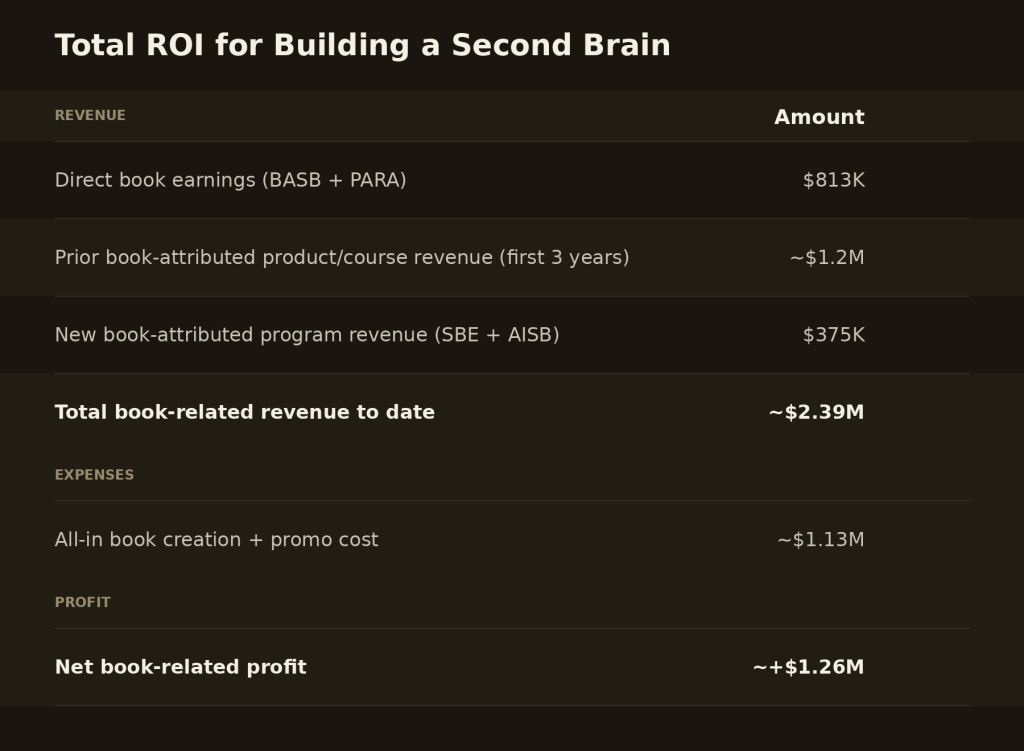
Our first major attempt was a business-focused program called Second Brain Enterprise, a joint venture designed to apply the concepts of BASB, plus AI, to small and medium businesses. We ended up not continuing it for a variety of reasons, but even as a short-term experiment, it added $450,000 in revenue. Assuming a conservative 30% of sales came from the books (as reported by our customer surveys), that’s $135,000 added to the book’s bottom line.
In spring 2026, we launched another live program, The AI Second Brain, that I think will become our next flagship and the successor to BASB for the AI era. The first cohort grossed $800,000, and at 30% attribution, adds another $240,000 in book profit.
Now we’re at $2.4 million in total book revenue, with about two-thirds of that ($1.6M) coming from products and programs. Minus $1.1 million in costs, and the grand total is $1.3 million in profit and counting.
For me, this highlights an incredible upside of books: They play out on such a longer timescale than any other kind of media, that you have more time to experiment and grow. The fact that I could take several years to come up with the next thing, and still have the attention of some segment of my readership, is a remarkable benefit in this ever-accelerating age.
Each publishing path is its own game
I’ve spent quite a bit of time comparing the different publishing pathways, which can be roughly divided into three:
- Traditional publishing – through an established publishing house
- Self-publishing – usually through Amazon
- Hybrid publishing – the newest of the three, which is a mix of different elements drawn from the other two
I’ve tried the first two of these paths, and the numbers somewhat speak for themselves: 96.8% of all my sales are from my two traditionally published books.
But this just highlights that each path is really its own game and its own world, with unique dynamics, tradeoffs, and rewards. They’re not direct substitutes for each other. On the surface, the goal of each model looks the same: to sell books. But look deeper, and the way each of them proposes to do that, and why and how the effort is justified, is completely different.
As I’ve described in detail, the profitability on a per-copy-sold basis is far superior with self-publishing. I would have made roughly 4x more per sale using Amazon’s Kindle Direct Publishing – $9.65 per copy versus the $2.45 I’m getting now.
However, that doesn’t tell the whole story. There are still three main areas where self-publishing can’t compete with traditional: foreign editions, hardcover formats, and most of all, the reach, credibility, and authority that a major imprint still conveys. A Kindle edition was likely never going to bring me a Google Talk, an appearance on a morning TV show, or a World Bank speaking slot.
Notice that all three of these factors also enhance the attractiveness of my backend products: a sizable percentage of my customers and students come from outside the U.S., many of them made aware of my work through foreign editions. Hardcover formats occupy a more physical presence in people’s lives, keeping me more top of mind. And the credibility of an imprint makes a big difference in a crowded field full of charlatans.
Even within one pathway, there are different games you can play. It’s been so surprising to me that the predominant format for my books – 38.5% of them – is audiobooks, since I don’t tend to consume audiobooks myself. I’m left with the odd conclusion that I’m mostly an audiobook live performance scriptwriter, pretty much the last profession I ever thought I’d have, since I don’t even like talking. But this data point tells me that I have to prioritize the audiobook experience by, for example, doing the recording myself rather than hiring a voice actor.
The third publishing model, which I haven’t tried yet, is in many ways the most promising and intriguing – hybrid. It’s the hardest one to wrap your mind around, since it encompasses such a wide array of possible configurations.
You could keep it simple and go with a hybrid publisher that is mostly similar to traditional publishing houses but with a better payout model for authors, like Page Two Books and Author’s Equity. Or you could explore the cottage industry of different micro-imprints, digital publishing services, and even individual freelancers to invest in exactly the kinds of quality you most care about on your own dime.
Growing your audience changes the audience
Another way of framing the business impact of my books is that they massively grew my online audience – by more than 50x over 6 years across all platforms, from about 13,600 when the proposal was acquired to more than 700,000 today.
Of course, that was also due to an enormous amount of effort we put in over that period creating mountains of content across all platforms (e.g., YouTube). But I think the books were central, both as flagship marketing assets and as the subject matter of most of that content.
That kind of audience growth may sound nice, but it’s brought an unexpected side effect: you cannot grow an audience without also changing that audience.
You change who’s in it – it’s not just tens of thousands more of the same kind of person who joined in the early days. They tend to be more mainstream, more conventional, less nerdy, and to see you through the narrow lens of the book they read.
You change their relationship to you and to each other – you are no longer an unknown, undiscovered singer playing to a few stragglers at the local dive bar. You are more like a celebrity, commanding attention and respect. That inherently means a less personal relationship. You just don’t have the time to talk to so many people individually, as much as you want to.
You change your relationship to the wider public – this one has been the most surprising. Once you have a certain magnitude of following, that group itself creates a kind of reputational gravity that ripples even further out to people who don’t directly follow you. It happens through algorithmic recommendations, as your content gets spread to people who may never have heard of you before. It happens through your followers reposting, commenting on, or riffing on your ideas, and therefore spreading them.
All of this means that you have much more of a reputation, a brand, and a defined niche in the eyes of the public. You can’t escape it – you’ll notice it in the ways people introduce you, talk about you, attack and defend you, and recognize you in public. You’ll notice it in how you get placed into a distinct box with a label, and then kept there despite your attempts to escape it. This is all the price of fame, I guess.
This evolution of your audience also changes your relationship to many of the people who joined in the early days. I noticed that as my writing and content moved more and more mainstream in preparation for the book’s release, many of my original hardcore followers felt that I was dumbing down or diluting the subject. Some of them felt disappointed or even betrayed by me. They reveled in the obscurity of PKM at the time – in the nerdy and intricate beauty of complex ideas that few others appreciated – and thus saw my attempts at popularizing those ideas as a form of “selling out.”
This raises a paradox: you end up disappointing and turning away the very people you most depended on to get you where you are. Writing for a mainstream, relatively novice audience, as you must do in a book, cost me the trust of my most hardcore supporters. What kept me going, and what has ultimately led me to embrace this shift, is seeing all the people who’ve now gained access to new capabilities because of my writing: those who aren’t as tech-savvy, who don’t have as much education, who live outside Silicon Valley and the US. In other words, people who’d never before heard of the concept of a “second brain.”
And this evolution of one’s audience, I’ve found, keeps going. After you’ve reached a certain authorial prominence, you can never really play the role of “revolutionary upstart” again. If you succeed in gaining authority, well, now you are an authority, an incumbent on the political playing field. There’s a certain loss of street cred entailed in this. You no longer get to be lauded for your innovative and contrarian takes, only your authoritative and respectable ones. You no longer easily fall in with the cool kids inventing culture on the margins. Only the business moguls making deals in back rooms.
The upside is that, as your following grows, a new hardcore base emerges. It’s the approximately 2.4% of readers who leave a review on my book. Who tell their friends and colleagues and employer and their own followers about my work. Who enroll in my courses and go further with me in their learning. Like a political leader moving from a state-level to a nationwide office, your base of support expands.
The advance is venture capital, not income
Traditionally, the “book advance” that kicks off the publishing process was meant to be used to sustain the author’s living expenses over the long period when they’d be writing the book.
From the perspective of a business book, that reality is quite different. You likely have other sources of income, so you don’t need to cover the rent. But that doesn’t mean you don’t need the advance.
The best way to think about it is as a venture capital investment. It’s a one-time sizable infusion of capital that you can use to build a bigger platform. In my case, I plowed most of that money into three things:
- Building up our financial reserves so we had more security and could justify taking greater risks
- Hiring a team to manage new projects and systems
- Building out my YouTube channel and production pipeline
The YouTube channel in particular was a big, non-obvious bet that has since paid off handsomely – it’s grown from a couple thousand subscribers to almost 400,000 in the last 5 years. YouTube is now responsible for about 36% of our sales, another third on top of the third that the books bring in.
This is, I believe, the best place to spend any money you invest in a book launch: not on temporary, one-off efforts, but on building durable, long-term online platforms you own and control. The most prominent ones besides a YouTube channel include a podcast show, a blog, a Substack publication, a newsletter, or a social media following. And it’s worth keeping in mind that even many of these are technically borrowed and could be lost at any time. Only your blog and email list are truly your own.
The specific platform matters less than the size and engagement of the people who subscribe or follow you there. Even a small following of 10,000–20,000 hardcore supporters can move mountains in an attention landscape that gets more fragmented every day, as it did for me. Concentrated attention beats mass attention.
While it’s possible to get started creating content using your own personal time and effort, being a creator long term requires that you create a system. You need a publishing calendar to organize your time and plan in advance. You need a small team, or at least a part-time contractor or two, to serve in specialized roles. You need digital systems and AI for everything from ideation, to production, to publishing, to analytics.
The creators that I see succeed are those who endure for the long term, and the ones who endure are those who recognize the limits of their time and energy early, before they’ve burned out completely, and who invest not only time but also money in creating these kinds of systems around them. In a way, the concept I teach of a “second brain” is itself one such system, giving you a centralized place to store and cultivate your ideas for the long term.
The upside of investing in durable, owned platforms is that they serve you for your book launch, but they don’t go away after that. They continue working day and night – on future book launches, product or course launches, or really anything else you want to promote, communicate, or share in the future. That’s why I really recommend focusing your efforts there.
Your owned platforms are the only thing you really control; everything else is borrowed.
Writing a book is a project of projects
One thing that’s really hard to wrap your mind around is just how much of your time, energy, attention, and focus writing a book of this magnitude will absorb.
Aspiring authors tend to have a very romanticized view of what being an author entails. A quaint log cabin in the woods, a steaming mug of coffee, some violins playing softly in the background, or some version thereof.
There are some brief moments where that vision is accurate, but most of the time it looks far different: endless meetings with a wide array of people; round after round of planning and prep; sending outreach emails and triaging cold pitches; creating the backend products I’ve detailed above; and if you have a team, then add several layers of hiring, management, and team coordination.
A book is not a project; it is a dozen or two closely intertwined projects, each with its own goals, constraints, deadlines, and desired results. All of which have to be individually tracked, managed, and pushed to completion, usually with an unforgiving deadline. Even relatively narrow endeavors, such as finding an agent, can grow to encompass months. More than half my time, I would estimate, was spent on these supporting projects, not on the book itself.
Yet none of that properly conveys what I’ve found to be the greatest challenge: the ever-increasing cognitive load that moving the book forward requires. In the beginning, it’s relatively easy, an empty canvas of possibilities. You feel nonchalant about putting things down, because you know it will all go through many rounds of editing and culling.
But as the manuscript grows, the cognitive load compounds. You start needing an hour to open up all the various documents, arrange your notes, update your to-do list, and remember where you left off, just to be able to write the next word. Eventually, it seems to take half your effort just to stand still. If you have to take a day off to work on other things, or simply take a break, the cognitive effort needed to bring yourself back up to speed is even greater.
This phenomenon is, I believe, the main reason that it takes years to bring a book to market. It’s not the literal time putting words on screen – that probably adds up to no more than a few months if you did nothing else. It’s not even all the peripheral projects I mentioned above, which probably add another few months. It’s not even the slowness of the traditional publishing process – it’s again only a few months from when I submit the final manuscript to when it appears on store shelves.
It’s that you have to string together hundreds of deep focus sessions into a coherent arc, while juggling all your other responsibilities and trying to live a functional life.
The only answer I’ve found to work is to be pretty extreme in my scheduling: refusing any commitment that took place before noon, to protect my prime working hours in the morning; spending freely on anything that would save me time, including meal delivery and house cleaners; and leaning on my team to make most day-to-day decisions and on our families to help with the kids. Which just shows how writing a book is a team endeavor – the only way it is possible for me is because I have about a dozen people supporting me in various capacities.
Even as I give this advice, I think this is perhaps my biggest regret about my books: I always fail to completely take into account how much it will demand of me. It’s too tempting to take on other things, to ignore my needs for rest and recovery, and to treat the book as “just one more project” among the many that I’m pursuing at any given time. This typically creates a crushing period around the late stage deadlines, when my failure to properly clear the decks causes my health and my family to bear the brunt of my overwork.
Playing the long game
The aspect of being an author I find most fascinating these days is the long-term horizon, which I feel rarely gets commented on, even in the book world. A bestselling book should be understood as a decades-long compounding asset, and yet there’s little in our business culture that encourages us to see it that way.
As BASB reaches half a million copies sold, it continues to sell 8,672 copies per month on average, like clockwork. On that trajectory, it is almost certain to reach 1 million copies sold in about 5 years, especially considering that about one-third of foreign editions haven’t yet reported any sales. That number is the Mount Olympus of publishing, achieved by a vanishingly small number – 0.001% of published books, well under one in ten thousand.
So this is already a career-defining event. Which is amazing. But also strange to realize that this one book, my first, is likely to follow me for as long as I live.
From a financial and business standpoint, that’s fantastic news. But from a personal identity perspective, I’m not so sure. I’m wary of the many ways that such a reputation could limit me, either through the kinds of outside opportunities that come my way, or the internal limits I place on myself and my identity in order to protect that identity.
I already feel the pressure in the form of the kinds of books I might write in the future. The business case for any book that is related to BASB is naturally far stronger, as a way to double down on a property that’s already achieved escape velocity, versus other topics that aren’t related and thus full of risk. I understand now how actors can easily get typecast and keep playing the same role in movie after movie – it’s so much easier, so much less risky and better paying, and the whole industry roots for it.
The success of my book has surfaced a paradoxical principle for me: at the peak of success, you have the least control. I think that’s because my definition of “success” – which for me is about impact, reach, influence, and financial sustainability – doesn’t depend only on my personal creativity or effort. It is the product of an intricate machine, built up over years, encompassing countless people and systems and platforms and supply chains I can scarcely imagine.
That machine has its own priorities, its own goals, its own particular kind of fuel that it hungers for more of. Tangibly, it means that likely anything I do in the future, not only in books but across any aspect of my work or business, will be far likelier to succeed if it is related in some way to BASB. The whole landscape of possibility I’m facing now has tilted in favor of this concept. Which is so strange to me because I’ve always seen notetaking as merely a preliminary step, a way to educate and prepare yourself for the main event. Now I’m not even sure what that main event is or should be.
Writing a book and releasing it to the world is, in a way, letting go of it. You package it up and give it a stand-alone identity so it can run across the world on its own two legs, but then, like a child who has moved away from home, that means you’re suddenly no longer in control.
Of all the things that a runaway book can do on its own, selling tons of copies is surely among the most desirable. But it is not without costs. The cost of widespread attention and impact is that you’re no longer free to fully control your narrative. It’s in the hands of the public now. That could mean you’ll be criticized or critiqued, or labeled a certain way fairly or unfairly. Or it could mean that you now labor under an expectation that you’ll deliver more of the same.
If you’re an aspiring author and already have a following, you can likely directly apply my lessons to your situation. But even if you’re starting without a platform or capital, the same principles apply: the book is the campaign, not the product; build one owned platform; design the next step before launch.
I’ve placed every blog post I’ve ever written about the bookwriting process, totaling more than 33,000 words, into this public notebook on NotebookLM. Ask it any question you have – about the writing process, proposals or acquisitions, marketing or launches – and it will use AI to draw on my lessons learned and give you an answer.
Follow us for the latest updates and insights around productivity and Building a Second Brain on X, Facebook, Instagram, LinkedIn, and YouTube. And if you’re ready to start building your Second Brain, get the book and learn the proven method to organize your digital life and unlock your creative potential.
- Posted in Books, Strategy, Writing
- On
- BY Tiago Forte