
In the early 2010s, the gaming startup Tiny Speck was a darling of the tech industry. The company had raised $17 million. The launch of its first game, Glitch, was covered by international media, including The Guardian and The New York Times. Within months of launching, it had tens of thousands of active players.
But despite the external signs of success, the founder had a sneaking suspicion that the company was not on the right path. So he did something that others might’ve seen as insane. Less than two years after launch, with millions of dollars left in the bank, he decided to shut the game down.
But instead of calling it quits, the founder decided to lean into the unknown. He offered to make his investors whole, downsized the team, and, with the remaining employees, got to work on a product in an entirely different industry.
While developing the game, the team had built a prototype for an internal messaging tool to help them collaborate. The founder decided to go all in on the messaging tool. That tool, Slack, became one of the fastest-growing enterprise software startups of all time. And its founder, Stuart Butterfield, was anointed as one of Silicon Valley’s most visionary entrepreneurs.
“I would love to say that we knew all the answers in advance,” Butterfield said, thinking back to his decision to shut down Glitch. “But the truth is that we discovered our product and opportunity, rather than planning for it.”
The moral of the story isn’t that all’s well that ends well, though the fact that Slack sold to Salesforce for nearly $27 billion wraps the case study up with a bow. The moral is that unless leaders are willing to face uncertainty head-on, they’ll never discover the possibilities awaiting them on the other side. The key is to develop uncertainty tolerance.
How To Not Know
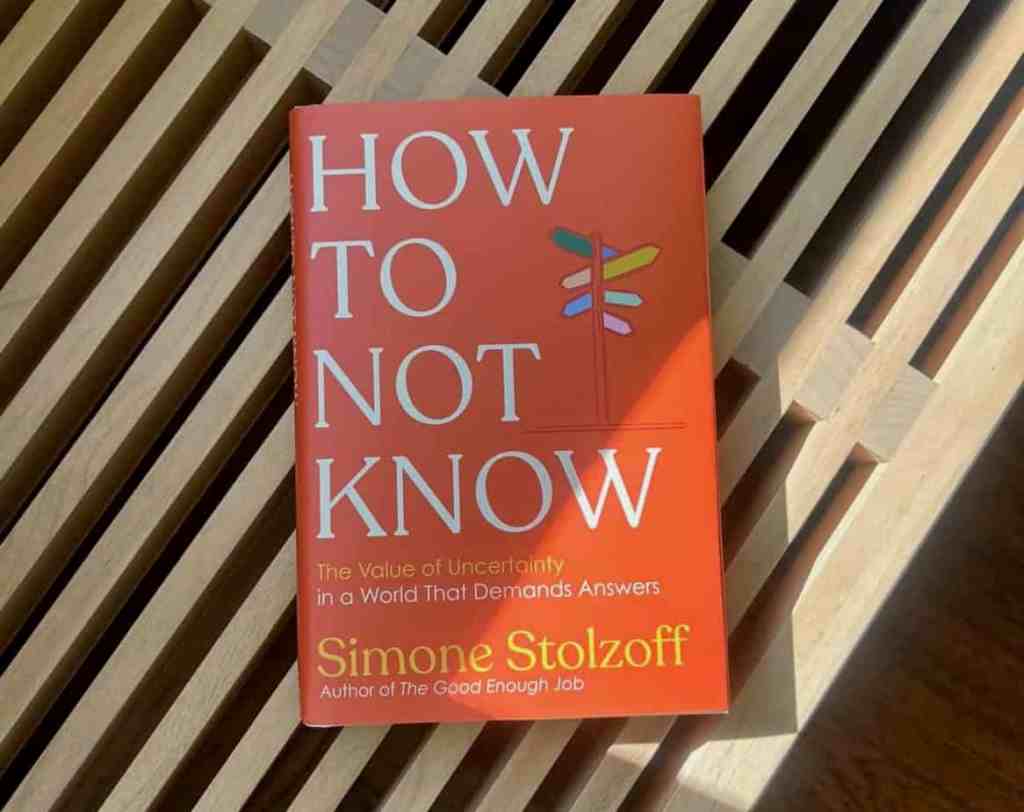
I’ve spent the last three years researching and writing a book called How To Not Know. It’s a guide to navigating the unknown. As you might imagine, I found that uncertainty tolerance is not just important for startup founders but for anyone at a crossroads.
Without uncertainty tolerance, we risk getting stuck at what statisticians call a local maximum. Like a mountain climber standing at the top of a hill, unaware of a taller peak just out of sight, our discomfort with uncertainty can keep us wedded to a business strategy, a job, or a relationship that is safe, but not optimal. Uncertainty tolerance allows us to persist through ambiguity—and it has never been more relevant.
According to the Economic Policy Uncertainty Index, an academic project that tracks global economic policy uncertainty, the five highest measurements of uncertainty since the study began collecting data in the 1980s have all occurred in the past five years. Mentions of uncertainty in Glassdoor reviews are up 80% year over year. And the word itself appeared in 87 percent of public earnings statements last year.
It’s not just that the world feels incredibly uncertain. This increase in uncertainty has coincided with a decrease in our ability to tolerate it. Research shows that the rise in uncertainty intolerance, perhaps expectedly, is positively correlated with the rise in mobile phone use. Phones, and more recently, AI chatbots, do two things.
First, they create the expectation that answers should be readily available. We have begun to treat life’s big questions, like who to marry or what to do for work, as if the only thing blocking us from wisdom was the right ChatGPT prompt. Second, they rob us of the practice of sitting with what we don’t know. Where I might have once been satisfied with not remembering the name of a given actor, I now, almost involuntarily, reach for my phone.
The Devil You Know
One reason uncertainty is so hard to deal with is that our minds tend to drift toward worst-case scenarios, overlooking the potential upsides of facing it.
Let’s try a thought experiment.
Imagine two silk bags, each with a mix of 100 red and black balls. In the first bag, there are 50 red and 50 black. In the second, you’re not sure about the mix. If you draw a red ball from either one, you get $100. Which bag do you reach into?
If you’re like most people, you’ll reach into the bag with the known quantities of red and black balls. If you know someone is watching you make the choice, you are even more likely to pick from bag number one.
Our tendency to favor known risk over unknown risk is called ambiguity aversion. The concept was popularized by Daniel Ellsberg (the same guy who leaked the Pentagon Papers) in 1961. Ellsberg found that people prefer choices with calculable risk, even when the unknown alternative might yield a better result.
Butterfield’s decision to sunset Tiny Speck illustrates what we stand to gain by overcoming our ambiguity aversion. We can reach into the second bag and find something even better than what we imagined. But first, we must be willing to tolerate the unknown.
How to Build Your Uncertainty Tolerance
So, how do we actually increase our uncertainty tolerance? Here are five practical steps you can take to get better at dealing with what you don’t know.
1. Find your anchors. When we are certain about some aspects of our lives, it makes it easier to hold uncertainty in others. For example, getting clear on your values or a commitment to live in a certain place, might make it easier to hold uncertainty in your career or relationships.
Ask yourself: What are aspects of my life that are likely to remain steady even if the future looks very different from today?
2. Separate what you can/can’t control. In the words of the Serenity Prayer, “Grant me the serenity to accept the things I cannot change, the courage to change the things I can, and the wisdom to know the difference.” For example, by shifting your attention from the existential threat of AI to what you can do to build your own AI fluency, your agency can absorb some of your anxiety.
Ask yourself: What am I wasting energy worrying about that I have no power to control?
3. Build your conviction with evidence. One of the best ways to become more comfortable with uncertainty is to remind yourself of times you’ve navigated uncertainty in the past. For example, perhaps there was a time when you thought “your life was ending,” that actually turned out to be the beginning of a new chapter.
Ask yourself: What is a time when I was able to navigate uncertainty in the past?
4. Plan for multiple possible outcomes. Anchoring your identity to a single vision of the future is incredibly brittle. Strong leaders mitigate risk by planning for multiple potential scenarios, not just one. Just as investors benefit from diversifying the stocks in their portfolio, we too benefit from diversifying our identities and sources of meaning.
Ask yourself: How might I respond if I got a best-case, worst-case, and neutral outcome?
5. Choose curiosity over fear. Part of the reason uncertainty is so uncomfortable is that our brains have a natural tendency to catastrophize. But uncertainty can also be the birthplace of possibility. Research shows that when we’re able to approach uncertainty with curiosity instead of fear, we are literally able to see more potential paths.
Ask yourself: What is my anxiety about the future telling me about what I care about?
Uncertainty isn’t always a problem to be solved. It’s an inevitable part of business and life. Especially now, as the stable careers and institutions of the past break down before our eyes, those with greater uncertainty tolerance will be able to more gracefully adapt to whatever the future holds.
If you want to get better at building your uncertainty tolerance and get more practical tips like these, check out How To Not Know. In a world that grows more uncertain by the day, building your uncertainty tolerance is an increasingly vital skill.
Simone Stolzoff is an author and journalist based in San Francisco. His work has been featured in The New York Times, The Atlantic, and on the TED stage. His debut book, The Good Enough Job, was translated into over a dozen languages. His new book is How To Not Know: The Value of Uncertainty in a World that Demands Answers.
- Posted in Books, Emotions, Entrepreneurship, Personal growth
- On
- BY Simone Stolzhoff (Guest Post)