
2021 was the hardest year of my life.
It all started, as so many things these days do, in 2020. Our entire lives changed within the span of a few months that year, from moving back to the U.S. from Mexico City in March, to buying and moving into our first home in May, to welcoming our son Caio in October.
On top of all this personal change, the business exploded in 2020 as online education rose to meet the challenges of the COVID pandemic and lockdown. We expanded our marketing, hiring, and operations to meet the demand, thankful that we were spared the impact that hit so many other businesses.
I thought we handled all of this very well in 2020. Little did I know, all this change was building up like a deep underwater swell. In 2021, that hidden swell became a tsunami wave.
Looking back, the common factor in everything that felt challenging this year was chronic sleep deprivation. For the first few months after his birth, Caio slept like an angel. With the help of the miraculous Snoo, an intelligent bassinet that rocks babies to sleep based on their movement and sounds, we floated peacefully in the calm before the storm.
Around February of 2021, the Snoo stopped working, and our lives were thrown into chaos. Caio started needing multiple attempts to go to sleep, and then awoke several times throughout the night. At around 5 or 6am, he would wake up for good, which meant at least one of us had to be up and about.
Even with the help of books like The Happy Sleeper (affiliate link), which I summarized for quick reference, and plentiful advice from our moms who together raised 9 children, we struggled all year to get enough sleep. This chronic lack of sleep in turn took a toll on every aspect of our life – Lauren and I made worse decisions about what to eat, skipped exercise because we were too tired, felt more reactive and temperamental at work, and were less patient and understanding with each other.
I found that sleep deprivation is cumulative. It builds up and compounds so that 2 months of insufficient sleep is more than two times worse than 1 month. It’s like being jetlagged, or drunk – a pervasive cognitive tax that makes everything seem more dramatic, more threatening, and more overwhelming. Sleep scarcity makes everything else also seem scarce.
Instead of taking things easy and giving ourselves more time, we hit the gas pedal on the business even harder. From the moment I signed a book deal in April 2020, it has felt we are on a fixed timeline marching toward publication. 2021 was the pivotal year to finish the manuscript, build our team, design and launch the promotional campaign, and open the earliest pre-orders for the book. None of that was going to wait, and I didn’t feel like I could either.
This meant that the months of peak sleep deprivation coincided with the period when I needed to do my best thinking to finish the book manuscript. On many days I struggled to get through even just one page. The result was too many days spent in survival mode this year. Too much time when I felt my time horizon shortened, from months or weeks to days or hours.
I often found myself ignoring everything that wasn’t needed to get through the day. I ignored the consequences of my short-term decisions, whether that meant letting the laundry or dishes pile up, ignoring household maintenance, or ordering takeout for the fifth time in a week. Living in survival mode is like spiraling into debt. Each day adds to the pile of future problems you know you’re going to have to face
It doesn’t matter, because you know you won’t be around to experience those future consequences if you don’t make it through the next few hours.
In last year’s review, I wrote: “It’s become very clear to me that becoming a ‘family man’ is a decision. It doesn’t happen automatically just because you have a kid. It’s a distinct identity shift that I think has to be by choice. My intention for this year-end review is to lay the foundation for my shift from a work-obsessed to a family-centric life, with my son and wife at the center of my universe. I want everything else in my life to be in service of them, simply because nothing else matters as much as them.”
Oh how naive I was.
The truth is that it’s taken me a full year since the birth of our son to even begin to truly understand how he’s changed our lives forever. If I’m honest with myself, a lot of the reason the year was so hard is that we didn’t make the lifestyle changes needed to accommodate him.
For example, it’s now clear that we are going to be waking up at 6 or 7am for the foreseeable future, which means we need to go to bed much earlier, around 9pm instead of our usual 11pm bedtime. We put Caio to bed at 7pm every night, and we got in the habit of treating 7-11pm as “our time.” When in reality we have only a couple hours after he falls asleep before it’s time to begin our own bedtime routine.
There are so many other changes that we only began to integrate in 2021. Travel is far more complicated than before and even short trips require a lot of preparation and planning. The daily routine of feedings, naps, and walks is paramount, and disrupting it is hardly ever worth it. We lived relatively carefree and adaptable lives before Caio arrived, but now I’m learning that a rigid routine is a gift to all of our circadian rhythms.
Despite all these challenges, 2021 was also the best year of my life. Paradoxical, I know.
Having kids is like taking a massive fisheye lens to your life. Everything gets exaggerated, for better or worse. The good parts become amazing. The not-so-good parts become truly awful. Very little is left unchanged or untouched. The small moments – the first time he laughed, the first time he flipped over on his own, the first time he crawled – impart an almost incalculable joy at the most unexpected times. So many everyday moments feel infused with meaning, as I remember my own childhood and share in the delights of his discovery of the world.
Let’s begin this year’s review by revisiting the goals I set in the last one.
2021 goals revisited
Grow my email newsletter list to 100k
A year ago I wrote, “In 2020 I averaged 86 new subscribers per day, taking into account unsubscribes, and to reach this goal in 2021 I’ll need to approximately double this to an average of 164 per day.”
What actually happened? We grew the email list from 39,909 to 54,880 subscribers, or a 37.5% increase. That comes out to an average 42 new subscribers per day, net of unsubscribes. Instead of doubling our growth rate, we halved it!

Obviously this isn’t what I wanted, but I also understand why it happened. I was barely able to give email growth any attention this year, and the fact that it did even this well is a testament to the power of evergreen content. We’ve just made our first full-time hire focused completely on audience growth, and I expect we’ll turn this around in 2022.
Maintain our focus on our two flagship courses
A year ago I committed to focusing on our two flagship courses, Building a Second Brain and Write of Passage, and to not create any new courses or products. We did that successfully, and experienced tremendous growth and innovation as a result.
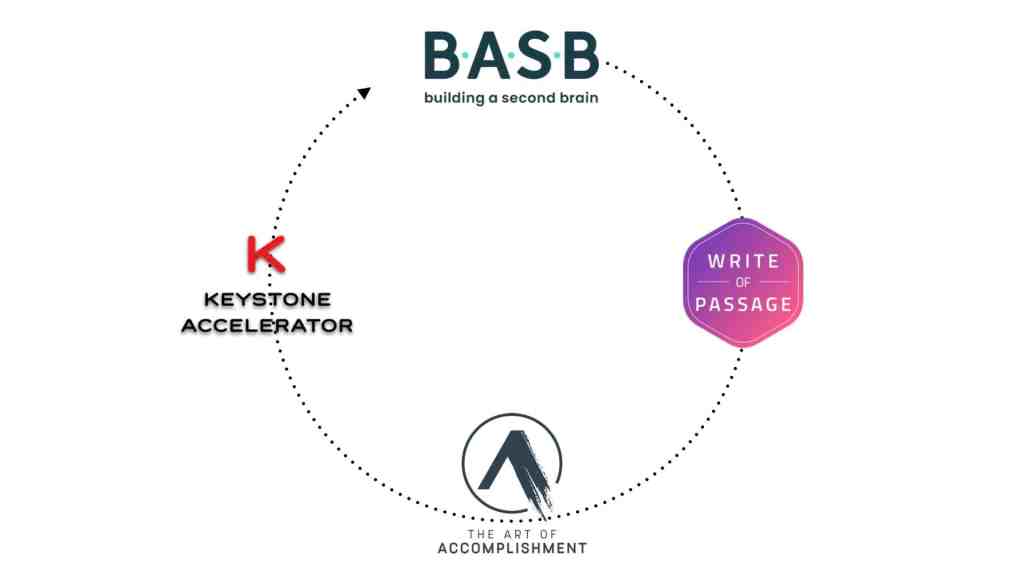
The two online programs I helped launch in 2020, The Art of Accomplishment (taught by Joe Hudson) and the Keystone Course Accelerator (taught by Billy Broas), held their second cohorts this year with incredible results. I’m beginning to see these 4 programs as a larger ecosystem, amounting to something like a complete education for anyone seeking to develop and share their ideas online:
- First people take Building a Second Brain, learning how to master their knowledge workflow and develop new ideas over time
- Second, they take Write of Passage (taught by David Perell) to learn how to express their thinking and expertise in writing for a public audience
- Third, if they want to go deeper into the personal growth that always represents the true bottleneck on entrepreneurial growth and creative self-expression, they take The Art of Accomplishment
- Fourth, if they want to follow in our footsteps and make an impact on others through their ideas, products, or services, they take the Keystone Course Accelerator and learn how to effectively market and scale their course, coaching, or information product
Altogether, these 4 programs represent about 22 weeks of instruction, and cost somewhere between $20,000–30,000 depending on the pricing tier and add-ons selected. In other words, it is comparable to a single semester at an elite university in terms of time commitment and cost. While offering, I would argue, vastly greater benefits for the investment versus what any university can offer.
I currently have no intention of centralizing these courses into a single curriculum or formally linking our offerings together. Every student is on their own unique learning journey, and it may only partially intersect with ours. And each instructor has to be free to evolve their course in the direction they see fit. I’m sharing this mostly as an observation, that individual courses that have individually found an audience can be combined into something much greater than the sum of their parts.
Launch 100 cohort-based courses through the Keystone Course Accelerator
After two successful cohorts of Keystone, it’s become very clear that the ideal target market for this program isn’t fledgling course creators. You have to have a product that’s already working before it makes sense to scale it. Billy has pivoted towards existing, mature course instructors who are ready to invest in creating a marketing flywheel, so this goal ended up being ill-conceived.
Going forward, it won’t be so much about bringing new courses into existence as much as magnifying the impact existing courses are having. Keystone remains my top recommendation for anyone seeking to follow in my footsteps and scale an online education business.
Run a live cohort with 2,000 students at once
We very nearly did this, with cohort 12 of Building a Second Brain counting more than 1,600 new students and returning alumni combined. From that first small cohort of 30 people, we’ve now taught more than 5,000 learners from more than 100 countries how to build a Second Brain.
I wrote last year, “…we’re going to have to reinvent many of the ways that traditional universities have scaled learning in the physical world. We’ll need teaching assistants who can cater to the individual needs of students, labs that take the theories and apply them experimentally, self-organized study groups where students take the initiative, electives and seminars that students can mix and match into their own majors and minors, etc. The key is that the quality of the student experience has to get better, not worse, as we scale.”
Yeah, no kidding.
We made a huge number of changes and improvements to cohort 12 and 13 this year, which you can read about in depth here. At the same time, I’ve realized that we’re relying on the cohort to do too many things at once. Every 6 months we have to simultaneously:
- Iterate on the learning design and student experience
- Improve the core material based on past feedback
- Reactivate the community, which lies mostly dormant between cohorts
- Recruit and train new course staff and a new group of alumni mentors
- Plan and relaunch a whole new marketing campaign to communicate all these changes
Trying to do so much for each cohort makes them chaotic and stressful. Our desire to make the biggest possible improvements conflicts with our need to reuse and capitalize on existing assets. There is little continuity in staffing between cohorts, because we can’t afford to keep people employed for such long periods without new revenue, which means we have to retrain them every time.
All this has led me to conclude that it’s time to develop a new educational offering. We are envisioning a subscription-based, private learning community that makes the experience of building a Second Brain into a longer term, slower and steadier, more self-guided path. While pairing it with a community and roster of coaches to make sure that people get the feedback and accountability they need to be successful. We’ll share more about that soon.
Make operational excellence and customer service central pillars of our business
The truth is, the systems and people needed to scale to our current size are quite far beyond what I can manage or even understand.
I’ve gone from teaching and managing everything myself, to leading a team of over 40 people, including our own team and a group of freelance coaches and volunteer moderators. To navigate that growth, I’ve relied heavily on our Director of Course Operations Monica Rysavy, who joined early in the year, and on Course Director Steven Zen, who joined in September just before cohort 13.
We now have a centralized database of student records in Airtable that combines and integrates student data from over a dozen separate sources, including things like Zoom attendance, Teachable transactions, Circle submissions, and ConvertKit email engagement metrics, among others. We have a unified profile for each student that takes our course that shows us their choices and behavior across all the different platforms we use to deliver our program. We’re just at the beginning of what this database will allow us to do in the future.
A year ago I wrote, “To have the impact we want, we have to rely on frictionless operations to prevent trouble before it arises, to help customers solve their own problems, and to use content and education to make customer support a value-add instead of a backup plan.”
We’ve built the systems to deliver on the first part of that promise, and next year I want to use it to make our customer service the best in the industry.
Redesign BASB brand identity and apply it to new website
We barely got this done before the end of the year, but I’m proud to say we now have a beautiful, comprehensive, deeply thoughtful visual identity for all things Second Brain! You can read all about it here: The New Building a Second Brain: Brand Reveal.

I previously wrote about this project, “My goal isn’t simply to have a pretty looking website. It is to unify the customer experience across all the different platforms and formats we use to deliver our education. A reader of the Building a Second Brain book should be able to finish reading, decide they want to go deeper, and sign up for the course without any friction or confusion. Branding is really about creating a world for people to inhabit, and making it as easy as possible to move within it toward what they’re seeking.”
We absolutely delivered on that goal, in partnership with designer Maya P. Lim, and I’m certain the new brand we created will powerfully support our efforts for years to come.
Hire Director of Content
Last time I wrote, “…after years of slow, organic growth based on my individual efforts and word of mouth, I believe we have all the major pieces to create a truly global, transformational media platform for teaching people how to work smarter in the 21st century.”
Along with Monica, we made three other key hires this year to support that vision: Marc Koenig as our first Director of Content in charge of all our content creation and distribution, Steven Zen as our new Course Director, and Julia Saxena as our first Marketing Manager focused on marketing and audience growth.
Back then it was only a wish, but with the dream team we’ve put together this year it now feels like an imminent reality. It’s difficult for me to overstate how much trust I have in this group of people to blow through our wildest ambitions. We have the benefit of drawing on an incredible community of people who already know what we do and believe in our mission, which has made it possible for a small, bootstrapped startup like us to recruit world-class talent.
Grow YouTube following to 50k subscribers
Not everything went so according to plan, and that applies primarily to my video ambitions.
Last year I wrote: “I’m going to make a major effort in the second half of 2021 to post more videos and grow my YouTube following. This will be partly the responsibility of the Managing Editor mentioned above, because the post-production process of downloading, editing, preparing, and uploading videos is one of the main bottlenecks to my current output. A second piece of this is the home studio we’re building in our garage, which will give me a space to set up the equipment without having to constantly take it down. And third, I’m going to look for a video editor that I can outsource editing to.”
I set a big goal for 2021 – multiplying our YouTube following by more than double, from less than 20k to 50k subscribers. The interesting thing about goals is that the level of ambition you set your sights on right at the beginning determines the very first steps that you have to take to be able to reach them.
For example, if you set a goal to sell 100 chocolate bars, you’d probably just start making phone calls and walking door to door in your neighborhood. You know that you easily have 100 chocolate bar buyers in your personal network, so there’s no need to build anything bigger.
But if you decide you’re going to sell 1 million chocolate bars, that’s an entirely different picture. Suddenly, it makes sense to start by building systems: striking a bulk deal with a local distributor, creating your own promotional assets, publishing a website, writing promotional copy, hiring a sales force, etc. It might be months before you sell even one chocolate bar.
Which means that paradoxically, the bigger your goal, the longer it will be before you make any visible progress on it. Now this is a very dangerous situation, because it is SO EASY to fool yourself into believing that you are responsibly planning and preparing, when in fact you are procrastinating on taking the most important action. On the surface, these two paths look the same, but they lead to entirely different places.
There are a few principles I use to make sure that my “planning and preparation” is not procrastination in disguise.
First, I always try the DIY route first to make sure I understand what’s involved in the new endeavor. I produced all my own YouTube videos for the past few years, 109 in total, doing everything from filming to editing to audio to uploading. That included my own complete mini-documentary, which I debuted last year, to make sure I truly understood everything involved in making in-depth videos. All these efforts led to a decent audience of 20k subscribers, which I felt was enough to give me a lay of the land.
Second, I always try to involve others as collaborators, feedback-givers, and accountability partners. Working completely on my own, it’s far too easy to keep postponing hard decisions and repeatedly miss the same blindspots. I knew that I needed personal accountability to get to the next level of video creation, which is one of the main reasons I hired our first Director of Content this year.
Marc made several visits to our home in Long Beach in 2021, including two of them to coincide with the remodel of our garage into a home studio, and a consulting engagement with studio design expert Kevin Shen to set up all the new cameras, lighting, and sound gear. All in, we invested over $100k in our home studio to make it the ideal venue for shooting live video with minimal fuss (including about $65k for the remodel itself, $10k on furniture and interior design, $15k on equipment, and $10k on consulting). We’ve also recruited two experienced freelance video editors who we’ll be working with on our post-production starting early next year.
This has all taken FAR longer than I expected: 5 months to remodel the garage, 3 months to recruit and onboard Marc, 2 months to set up and figure out how to use the AV equipment, and another 2 months to find a video editor. The amount of documentation and practice I’ve had to do to operate all this equipment has been staggering. To give you an example, we now have an over 100-point checklist we run through as a team before every live class session of our course, in order to ensure every little setting is right.
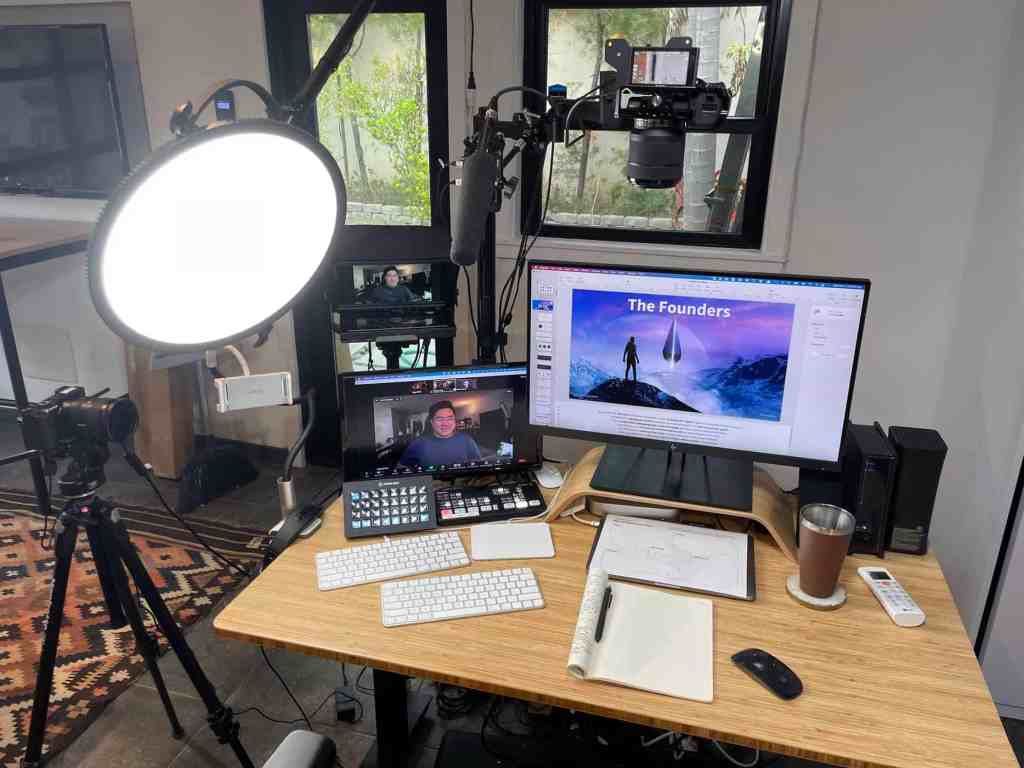
We’ve made tremendous progress, and our live Zoom setup now rivals platforms like MasterClass. Here’s an example:
But a side effect of focusing on the needs of the course was that we didn’t publish a single new YouTube video in 2020, except for a few informal interviews and updates. We are creating a system that should soon be capable of pumping out a steady stream of super high-quality, engaging, educational videos, which I hope to unveil for you soon.
Hire a personal trainer and work with them 90 times in 2021
I hired a personal trainer in early February, and mostly stuck to a schedule of two weekly hour-long workouts for the entire year. Minus a couple trips and sick days, I worked out with him 74 times this year. This is definitely the most consistently I’ve ever exercised in my life, and I’m the strongest I’ve ever been.
One thing I’ve learned is that exercise by itself isn’t enough to maintain excellent health. I also gained the most weight ever, due to a poor diet and neglecting smaller bouts of exercise (such as jogging) on my off-days. This is an interesting side effect of outsourcing my willpower to a professional: I felt less motivated to exercise on my own, knowing that the next “gym day” was right around the corner.
I recently spoke with a friend who described the 3 pillars of health: excercise, diet, and sleep. I plan on continuing to work with my trainer in 2022, and turning my attention to improving the other two pillars of diet and sleep.
A few other goals were abandoned or put on pause, mostly due to my lack of interest or inability to give them enough attention:
- Launch a second group of Praxis Fellows
- Establish Growth Board for Forte Labs
- Complete “Drawing on the Right Side of the Brain” exercises
- Record my first music album
- Meditate every day for 30 minutes
And we reached a few milestones this year that weren’t part of my official goals, but were rewarding nonetheless:
- Our first 7-figure course launch
- Released Season 2 of the Building a Second Brain podcast (which has now had over 300k downloads total)
- Made my first 3 angel investments in promising edtech startups, including Maven, SchoolHouse, and Circle
- Bought our first minivan, a Toyota Sienna, to transport our growing family
- Held our first team retreat in Escondido, CA
- Got our first dog, an English Lab puppy named Ximena
- Received over 2,000 pre-orders for my book Building a Second Brain (I previously estimated 4-5,000, which I learned was an overestimate)
- Hosted my first in-person meetup since the start of the pandemic, in San Francisco
- Signed our first three international book deals (in the United Kingdom and India, with the others to be announced soon)

My top lessons learned
Don’t underestimate the difficulty of moving atoms versus bits
I had to learn multiple times this year that any project taking place in the physical world is far more complicated, risky, expensive, error prone, and lengthy than those that take place digitally.
Not only with our studio remodel, but with the first two homes being built by my brother Lucas’ company Forte Shelter, I saw time and again that the physical world is a much less forgiving place. As I consider other projects that require moving atoms, not just bits, I’m tempering my expectations and preparing myself to spend more time and money than I expect.
People can do the jobs I delegate to them far faster, more deeply, and with more joy and enthusiasm
We crossed a threshold this year as we hired our first full-time course staff beyond a Course Manager. That seemed to unlock a new layer of the business, where for the first time, each person could afford to focus completely on one aspect of the product.
It’s been amazing to see just how deep we can go in areas like operations, marketing, curriculum design, mentor training, live streaming production, graphic design, and others when we have the collective bandwidth. I’ve seen our team begin to explore possibilities that I never would have thought of, much less been able to execute on.
Along with that, I’ve begun to let go of the feeling of total responsibility for every tiny little detail of the course. It’s not my responsibility to bear alone anymore. I don’t have enough caring to spread across all the people and all the needs that the course now encompasses. I get to borrow the caring of my team as a kind of extension of my heart, not just my mind.
The most surprising thing I’ve noticed is how different people are, and that a job I can barely tolerate, someone else can usually do with enthusiasm (or at least less aversion). This is a remarkable thing about humans working in groups: there is a fit between certain tasks and people’s minds, and my job as a leader is to create an environment where that fit can be identified quickly.
You cannot spark the entrepreneurial spirit in someone else – that is 100% their responsibility and only they can choose that path
Over the past couple years I’ve made a number of attempts to “help people become entrepreneurs.” I assumed self-employment was the best path for everyone, that I was uniquely lucky to have found it, and therefore I had the responsibility to show others the way.
I still want to share how I did it, if they want to follow it, but I’ve also learned that I absolutely cannot take responsibility for that inner spark of entrepreneurial drive that they must have if they’re going to succeed. If I try, I end up robbing them of their agency and setting them up for failure with too high of expectations.
Going forward, I’m broadening my definition of “entrepreneurship” to include any kind of self-started, creative, challenging endeavor, whether that is an actual business or side gig, an ambitious project at work, raising a family, or creating a life you are proud of. That wider definition allows me to share what I know without feeling on the hook for the specific business outcomes people produce, which no one can guarantee.
The community we’ve created is a vibrant and deeply heartfelt one
One of the few public events Lauren and I went to this year was a comedy show by Hasan Minhaj at the Microsoft Theatre in downtown LA. It was a jarring experience being part of such a huge crowd after so many months of avoiding groups of any size.
The show was sold out, and the theatre was packed with 7,000 raving fans who had all come together to see Minhaj perform. His style of comedy isn’t to tell jokes so much as it is to tell stories. Those stories are funny, but also vulnerable, heartfelt, meaningful, and relatable.
It reminded me, if I dare say so, of myself. This is what I do in my courses – tell stories that can be funny, but at their best are also heartfelt and meaningful. Stories are such a powerful means of teaching because they don’t rely on outside authority for their credibility. They are judged to be true or not true, useful or not useful, based on how they resonate with the listener. When you feel the truth of a story inside you, you don’t need to be convinced or persuaded to learn from it.
It was powerful to see a reflection of my own experience in Minhaj’s performance, but then I heard a voice in my head say, “Yes but he’s reaching a far bigger audience than you.” But then I turned around in my chair, looked at the vast number of people sitting in that theatre, and realized that the number of people who have taken my course isn’t so far off.
Feeling the collective energy of so many people, all aligned behind one cause, it hit me in the gut how powerful of a community we’ve built over the last 5 years. It’s easy to forget when it’s abstracted behind metrics and subscriber counts, but we’ve gathered one of the most formidable groups on the planet committed to capitalizing on the full potential of their knowledge.
Two questions have kept running through my head since that day: “What can 5,000 smart, dedicated people accomplish in the world?” And another, even more powerful question: “What can 5,000 smart, dedicated people not accomplish in the world?”
Ask “What is the unique role I can play?”
As the business has prospered and we’ve built up our reputation, a question I increasingly find myself asking is “What is the unique role I can play?”
I no longer want to do anything that anyone else can do just as well or better. I no longer want to waste my time replicating the past or future efforts of others, trying to excel in areas where I’m not excellent, and playing defense instead of offense.
As I look at the field I’ve found myself in – the emerging niche of personal knowledge management within the broader productivity ecosystem – it’s so clear to me what my purpose is within it. My role is not to develop or refine the technology or tools. It’s not to push the state of the art in advanced knowledge management frameworks or concepts.
There is really only one thing I feel uniquely equipped to lead – the popularization of PKM from a tiny niche into the broader mainstream culture. On a scale of 1-10, my job is to get people from level 0 to level 1 in their knowledge management skills, because once they are there, they will have the tools and the motivation to find all the other answers they need. So many others are doing such incredible work at levels 2-10, but with my story and my skills I am an ambassador that invites foreign travelers into this strange and magical land.
This is, honestly, a relief. I don’t need to stay on the absolute cutting edge of rapidly evolving technology. I don’t need to track all the new ideas and concepts emerging from the field. There is far too much going on for any one person or even company to keep track of. Instead, I get to pursue what I enjoy and use the Second Brain I’ve already created to live the life I want to live. And by doing so, I have the chance to be a role model for others. To teach by example, through who I am and what I do, not just by what I say.
What triggers you in another person is what you don’t allow yourself to feel
On a more personal note, I’m learning a lot about an idea called “projection”: that anything that irritates, aggravates, or triggers you about someone else is usually just a part of yourself that you haven’t yet learned to accept and love, which is being “projected” onto the other person like a mirror.
I’m often triggered when others present themselves as victims. Their helplessness feels threatening to me because I haven’t learned to completely embrace my own sense of helplessness, which is a normal and natural part of being human. The consequence of that is I fear any situation where I feel not capable, or uncertain of how to make progress, or simply too tired to give it my all. Which means that I miss out on a lot of opportunities for growth and enjoyment in domains where I’m not already experienced, and have difficulty accepting help from others or even recognizing when help is offered.
Lauren and I recently took part in a weekend couple’s retreat facilitated by a mentor of mine, Joe Hudson. One of the main themes of the retreat was that anything that triggers you about your partner can be seen as a chance to “own a projection.” Instead of treating triggers as something to be avoided and feared, we can welcome them as opportunities for growth. In long-term relationships especially, recurring triggers are like reminders of a part of ourselves we’ve rejected, which we have the chance to forgive and welcome back into the fold of our self-love.
There’s one more thing I’ve noticed through the process of owning my projections: everything you do to avoid an emotion is what invites it. You don’t want to feel rejected by others, so you hedge your statements and hold back from full commitment, which is what ends up getting you rejected. You don’t want to feel like you have power over others, so you avoid stating your wants or insisting on your boundaries, which ends up making you passive aggressive, a far more insidious and hurtful form of power. And by “you,” I mean “I.”
Working out regularly is not enough to be healthy – diet and sleep are the other essential parts of the equation
I often run an experiment to try and determine, in an area of my life that isn’t currently my focus, what is the absolute minimum I can do? It’s a much more fun and interesting experiment than the far more common “What is the most I can do?”
I ran that experiment with my health this year, in the midst of all the other new projects and responsibilities I took on. I hired a personal trainer to work with me twice a week to “outsource” my exercise to an external accountability partner, and signed up for a healthy meal delivery service called Methodology (which I highly recommend) to automate our eating.
The results of my experiment were clear: my health needs more attention than that. I learned that weight-lifting twice a week isn’t enough, no matter how hard I push myself during those sessions. I also need regular cardio and yoga or stretching to feel good. And while we love meal delivery, there is simply no substitute for home-cooked meals.
We’re making changes in the new year to pay more attention to all three of these main pillars of our health, and thinking about them as a family instead of only individually.
Your capacity may theoretically be unlimited, but the more important question is, “Do you want to make the tradeoffs necessary to expand your capacity?”
One of my fundamental, most deeply held beliefs is that human capacity is inherently unlimited. I don’t know where I got this belief, but I think it is part of the core engine of motivation that fuels my research, writing, teaching, and growth.
After the most punishing year in memory, I’m revisiting this belief and adding some caveats. I still believe that human potential is unbounded, subject only to the limits of physics (barely). But an important question that I want to ask myself next time I take on so much growth and change in a short amount of time is, “Do I want to make the necessary tradeoffs?”
Am I willing to have my limits tested and pushed? Am I interested in letting go of assumptions and limiting beliefs at the necessary pace? Am I able to depend on other people to the extent necessary? Do I want to take on the additional risk? Do I want to create the systems and routines in my life that will be needed to support that level of capacity? Am I willing to change how I think, how I work, how I lead, and how I delegate at the scale of the goals I’ve set for myself?
The crux of these questions is that they have to be tradeoffs I want to make, not just ones I am capable of or willing to make, which is the filter I used in the past. The main driver of my goals and ambitions is shifting from my needs, which are already more than fulfilled, to my wants, which are far more powerful and able to be shared by so many others. To tap into that greater source of power, I have to be completely aligned with my wants, my desire, and my source of pleasure in all areas of my life.
Boundaries don’t have to be policed or enforced; they exist because you said so
Another theme we explored in our couple’s retreat is boundaries. I thought I knew what they were – militarized psychological borders patrolled by heavily armed guards day and night, warding off the constant threat of invasion.
In one exercise, Lauren and I practiced saying “no” to each other over and over again. I found my “no” was hard and severe, like a wall of ice. This was because I believed subconsciously that the strength of the boundary was equal to my ferocity in protecting it. I found that at the moment of saying “no,” I dissociated a little and withdrew my love for a moment. Which left me with the unspoken impression that in order to protect my needs, I had to withdraw love from the people who matter most to me. It’s no wonder I’ve felt reluctant to enforce my boundaries.
As we iterated on our “no” over and over and over again, I discovered to my surprise that there were many flavors of “no.” I could say “no” softly, even affectionately, without withdrawing my affection for the person for even a moment, and it was just as strong. The power of that “no” came from its honesty, not its ruthlessness. I got in touch with the intensity of the self-love that lies behind every “no.” I saw that saying no is a radical act of self-care. And found that when I model such self-care for myself, the people around me feel permissioned to practice it for themselves.
Another word for “boundaries” is “needs.” Needs are your birthright. You don’t have to explain them, don’t have to justify them, and don’t have to earn them. You deserve your needs for the same reason you deserve to live.
Favorite problems
I always like to frame my explorations as open-ended questions, which I call my “favorite problems.” This year, I’m adding the following questions to my list:
- What does the simple version of this look like?
- What is my want?
- In this moment, how can I value presence over prep?
- What can 5,000 smart, dedicated people not accomplish?
- What is the unique role I can play?
- Do I want to make the tradeoffs necessary to expand my capacity?

Tiago’s 2021 Mid-Year Review
Published July 12, 2021.
One of the most useful exercises I perform each year is a “mid-year” review in June or July.
It’s great to set ambitious goals at the start of the year, but that plan often doesn’t survive contact with the real world for more than a few weeks. We’re like newborn babies flush with excitement for life, but who don’t yet understand how life works.
And looking back on the past year around January 1 is also a useful exercise, but by then it’s too late to make major changes. We’re like the elderly – full of hard-won wisdom, but without any time left to apply it.
But halfway through the year, there is a brief, liminal moment. You have enough information to know whether your goals are properly formulated, but there is also enough time left to change direction and finish the year stronger than you started.
This is a summary of my personal reflection process for mid-year 2021, which mainly involves a lot of reading, taking long walks, talking with the important people in my life, and journaling.
Its purpose is to check in with the goals I set at the beginning of the year, celebrate victories, and make any course corrections based on what I’ve learned.
1. Grow my email newsletter to 100,000 subscribers
This is my most important goal of the year, since the overall size of my audience drives every other business goal. In 2020 my weekly newsletter grew rapidly from 9,483 to 40,887 subscribers, or by more than 30,000. In the first half of 2021 I only added another 8,000, for a total of 48,352. In other words, growth slowed from 2,617 new subscribers per month last year to 622 per month in 2021, a 77% drop.
I’ve only begun to investigate why, but I have a couple solid hypotheses:
- Email list growth naturally follows an “S curve” as strategies that worked before become less effective, and existing sources of new subscribers run dry
- I spent little time and attention on it so far this year, in favor of growing the size of our cohorts and building the team
The deeper, underlying reason behind this plateauing is that I think I’ve reached the limits of what I can do as a solo creator sending emails on my own. I don’t have much interest in doing anything besides creating the content itself. I need someone to own this area of the business, from continuously finding new sources of subscribers, to managing the details of ConvertKit, to documenting and standardizing all the ways we use the email platform.
Half of this job will fall to our new Director of Course Operations, Dr. Monica Rysavy, who is working with our newly promoted Chief of Staff, Betheny Swinehart, on the operational side of email marketing. The other half will be the responsibility of the new Director of Content I’m hiring soon, who will manage the content side.
Besides building up this capability as a team, I’ve hired a promotional agency to work with us on the launch of my book over the next year. They’ve worked with some of the biggest names in online media on some of the biggest book projects of recent years, and will help us develop and execute a strategy for growing our audience as the primary lever in making the book a success.
2. Maintain our focus on our two flagship courses
I succeeded in staying focused on our flagship courses this year! Partly because of the accountability of having promised to do so on this blog.
I’m now beginning to think of our educational ecosystem in terms of three flagship courses: Building a Second Brain (BASB), Write of Passage, and The Art of Accomplishment (taught by our external partner Joe Hudson). Each of these courses trains people in an extremely important, yet challenging skill that can have a dramatic impact on their lives and careers – knowledge management, modern writing, and personal growth, respectively. They’re each taught by a uniquely qualified instructor, who is also dedicated to building it into a sizable business.
Each of these courses also checks all the boxes I look for in sustainable CBCs:
- Includes both concepts and practical implementation
- Professional/business-focused but including a strong personal growth component
- Driven by or leveraged by technology and the Internet
These three factors are the moat around our programs. They are difficult for others to copy and require skills not commonly found together. They straddle traditional boundaries of education, which means existing institutions are unlikely to offer something similar. And they have some inherent friction which makes them difficult to scale easily, which means venture-funded startups are unlikely to take them on either.
When I think about these three programs as a symbiotic trio, I think their potential is basically unlimited. There is no reason they can’t each become a $10 million dollar business in the next 5 years. Especially when we take into account vertical integration into books, coaching, paid subscriptions, and physical products around the same intellectual property, each of them is like an extended universe unto itself.
3. Run a live cohort with 2,000 students at once
We got close on this one already, with cohort 12 of BASB reaching just over 1,600 participants including both new students and returning alumni. It was a wild experience, akin to putting up a pop-up liberal arts college in the span of a couple months.
We tried a lot of different ways of making such a large group continue to feel intimate and personal. We had 30 Alumni Mentors delivering smaller breakout sessions each week. We created opt-in “feedback pods” where students could join a small group of students to discuss their progress and get feedback from each other. And we doubled down on making Circle the “town square” of the program. Hearing that people wanted a more real-time, chat-like environment, we also created a dedicated Slack just for this cohort, which we may reuse in the future.
Although each of these experiments was promising, I think we’re reaching a scale where we need to start putting limits on the size of the cohorts. I’m considering limiting the next one to 1,000 new students, plus 500 returning alumni. After that we can assess and decide whether to raise the cap incrementally, or standardize on that size so we can really master it. So much of the complexity of running cohorts comes from the uncertainty around how many students to expect, and although this limit would forgo some revenue, it will make our planning and the resulting student experience much better.
I’m also considering increasing the number of cohorts per year, from two to four, so we can continue serving more customers despite the enrollment limits. That would allow me to hire year-round staff instead of having to recruit a new group of mentors every cohort. And it would help us make longer-term decisions, in terms of semesters and academic years, instead of everything being a one-off.
4. Make operational excellence and customer service central pillars of our business
It’s been incredible to see the explosive interest in CBCs (Cohort-Based Courses) over the last year. The field is unrecognizable compared to when I started. Investment is pouring in, new startups are being formed, and it seems like cohorts are quickly becoming the default format for high-impact, premium educational experiences.
As excited as I am to see all this interest, it also means the landscape is becoming far more competitive. You can’t get away with a few casual Zoom calls anymore. Customers expect high production values, strong follow-up on their questions and comments, practical feedback on their work, real relationship-building amongst their fellow students, and a consistent and distilled experience throughout. I think we’re going to see a shakeout in the next couple years with quirky, personality-driven CBCs taught by solo instructors giving way to more professional, commercial programs run by teams. The plane of competition will shift from personal loyalty to operational excellence.
There are so many components and aspects to a CBC, and all of them are advancing rapidly. Which means we have a lot of work to do to discover, understand, test, and integrate new components. For example, here are some of the major areas of improvement we have our eyes on:
- Data collection, management, and visualization – How do we combine data from all the different platforms and tools we use and turn it into tangible improvements to the student experience?
- Mentor recruitment, training, and support – How do we double down on Alumni Mentors, and make their breakout sessions the most compelling and impactful part of the program?
- Evaluation and testing – How do we improve and expand the Second Brain Snapshot that students take before and after the course, and turn it into a personalized curriculum for the program itself?
- Live studio production – How do we upgrade the quality and reliability of our live broadcasts for the instructor, course staff, Alumni Mentors, and students?
- Calendaring and notifications – How do we radically improve the course calendar, and its ability to blend seamlessly into students’ lives with useful reminders without being intrusive?
- Video editing and distribution – How do we create a dedicated system for recording, editing, uploading, and distributing recordings of class sessions?
We’ve laid the foundation for making major investments into these areas, including hiring a Director of Course Operations, our first Customer Support Rep, and creating a series of internal systems to allow for more hiring in the coming months. We also built a solid support portal, including many FAQs and a support ticketing system for both the courses and inquiries in general.
5. Launch 100 Cohort-Based Courses through the Keystone Accelerator
We launched the first cohort of the Keystone Course Accelerator late last year, with about 35 participants teaching a wide variety of subjects.
The program produced some outstanding successes, but we also learned a difficult lesson: that there are SO MANY aspects of running a successful CBC, it isn’t realistic to expect any program to cover all or most of them. A CBC is a relatively advanced, mature product, meaning you need to have many foundational levels in place in order to make it work: an engaged audience of significant size; a team (or reliable contractors) you can lean on; an understanding of your customers and the most important need you can solve; an existing educational program that you know reliably produces great outcomes.
I think this is the biggest blindspot that the CBC craze is missing: people are trying to make a CBC as their first ever paid product, or in some cases, the first significant project they deliver online. It’s entirely feasible to attract some friends or colleagues for the first and maybe second cohorts, but after this close circle is quickly exhausted I think we’re going to see many instructors realize they don’t have any foundation in place to keep it going, much less scale it.
So we’re pivoting Keystone to focus only on existing education businesses who have that foundation in place, and are ready for growth. Instructor Billy Broas is going to zero in like a laser on the true bottleneck for such businesses: the core messaging that drives every other tactic, strategy, promotion, and piece of content. Messaging (including positioning, storytelling, and differentiation) that is truthful, authentic, and most importantly of all, powerfully effective in moving people to take action. Messaging is the keystone of a successful online education business, and no one does it better than Billy.
6. Redesign BASB brand identity and apply it to new website
We kicked off this project last month, and the two designers I’m working with are well on their way. The early results I’ve seen are incredibly promising. We are creating a comprehensive visual system for the BASB brand that will give us years of runway. It will provide the cohesiveness and shared context we need to extend the ideas developed in the course into books, workbooks, videos, local events, physical products, coaching services, subscriptions, and other media.
I don’t have anything to share just yet, but stay tuned as I begin to share bits and pieces of the brand as it emerges. It will culminate in a completely new buildingasecondbrain.com website by the end of the year.
7. Grow YouTube following to 50,000
I’ve mostly ignored YouTube for the first half of the year, as my attention has been dedicated to finishing my manuscript (which is due at the end of this month!). But I have big plans for it in the second half of the year.
The first step has been remodeling our garage into a gorgeous, 360 square foot studio. I’ll have a lot more to share on this project soon as it’s been a fascinating learning experience. But the main goal is to have a completely dedicated space for not only working from home in general, but filming and livestreaming as well. We made every decision to maximize the usefulness of every part of the studio for creating video content.
In the meantime, here’s a playlist of periodic construction updates I’ve shared along the way.
8. Hire a personal trainer and train with them 90 times
I started working with a personal trainer I found on Yelp on February 11, and so far we’ve trained 37 times, about twice a week on average. This has been an interesting way of framing it for myself, because 37 doesn’t seem like a very dramatic or impressive number. But the 5 months of progress have already been transformational, like a whole body education in what it means to be holistically strong and flexible.
I’ve had to learn how to stay consistent and make room in my schedule for two hour-long sessions per week. I’ve had to learn how to eat better, before my workout to ensure I have energy, and after to make sure I’m capitalizing on my effort. I’ve learned a ton about correct posture and form, the relationships between body parts, and how to avoid injury. The pain and tension I’ve had in my lower back for years is gone, and I have more energy and sleep better than ever.
It’s kind of amazing in retrospect that so many of us walk into gyms and begin lifting weights without any training as to how to do it properly. I’ve had to unlearn many bad habits and correct mistaken assumptions gleaned from TV or watching others. It’s been a relief to accept that I don’t have the self-discipline right now to exercise regularly on my own, and to feel comfortable outsourcing that self-discipline to someone else.
But I think the biggest benefit has been psychological. I have a newfound pride in myself that I am taking care of my most fundamental and important responsibility, my health. It makes me happy that I am setting an example for my son, that health comes first. I’m beginning to think of myself as a cognitive athlete. It may not matter how fast I can run or how many pounds I can lift, but to the extent my body is the foundation of my mind, I depend just as much on it as any pro athlete.
9. Becoming a parent
This wasn’t on my list of goals, but becoming a father has of course been the most monumental change of the past year. Our son is almost 9 months old, and over the past 6 months his personality has really started to emerge.
It feels in many ways like I’ve entered a different dimension. An alternate reality that operates by different rules. Things that seemed critically important – launching new products, spending as many possible hours per week in deep focus, traveling extensively – suddenly don’t seem important at all. Or even desirable.
Other things that I’d never given much thought to have become paramount – improving our family’s dietary habits, spending as much time as possible with my parents, understanding and healing intergenerational trauma (I’m reading a book called It Didn’t Start With You that has been very moving on this subject).
I think the deepest shift is that my own life – my goals, priorities, and freedom – is not the central focus of my life anymore. Instead, my attention is dedicated to what my spouse and my son need, want, and will become. It’s jarring to realize that I’ve had the great privilege of focusing entirely on myself until now.
Becoming a parent has also changed how I view a lot of “life advice.” A lot of advice that makes complete sense for single 20-somethings or childless 30-somethings makes absolutely no sense once you have kids. They are like different worlds with little communication between them. As I approach 40 and identify less and less with hard-charging 20-somethings giving their career or business every last drop of their energy, I can see that the content I create and the lessons I teach are going to change as well.
As a parent, I have far less time, and especially solo, focused time, than I did previously. My sleep is far more unpredictable. We are fortunate to have childcare until about 3pm each weekday, but that means that my workday effectively ends at 3pm. Whereas in the past I would get a whole second wind to work through the afternoon and into the evening.
Now I’m looking to other sources for inspiration. Not so much productivity gurus, but fellow parents who seem to live with ease and grace. Not so much the puritanical extremes of human performance, but the messy middle. I’m interested in leaders and business owners who are somehow able to maintain and even expand the impact they have without sacrificing the needs of their growing families. I feel like a beginner again, and that is a precious gift.
3 areas of innovation
I’ve long had this idea that the business just needed to mature, and then we’d reach this mythical plateau of stability where we’d have everything figured out and just sail smoothly into the horizon.
But now I understand that the only plateau is the plateau of stagnation. That change is the only constant, and it is our prerogative to get good at navigating it.
I’m starting to realize that every single year of the business requires a different strategy and even business model. We are growing quickly, approximately doubling revenue each year. Each doubling demands a different mix of goals, different roles for our team, and different kinds of partnerships and advisors.
From 2013 to 2017 I was in “solo creator” mode, experimenting with a broad range of projects, pursuing whatever resonated with me. In 2018 my Building a Second Brain course really took off, and the whole business reoriented to support it.
In 2020 we started hiring, ushering in a new stage of building a team that could deliver the course to a much larger number of students. We now have a team of 8 across two flagship courses. It’s been a wonderful experience to go beyond what I can deliver by myself, to watch others learn and grow alongside me, and to envision our future as a real company.
Now it’s time to shift once again. As strange as this sounds, it wasn’t until the past year that I truly committed to our future as an education business. There seemed to be so many interesting topics to learn about, and so many promising pathways to explore. Why would I commit to just one?
But the growth of the course alongside my newfound conservatism as a parent have combined to make it very clear to me that BASB is my big idea, the course is the breakout product, and the release of my book in just about a year is an opportunity to make it the definitive methodology on knowledge management, and productivity in general, on the planet. What GTD did for personal productivity, we can do for personal knowledge management (PKM).
Interestingly, this leads me to the conclusion that there are really only three areas of life that I want to innovate on:
- My personal growth
- My child’s education and upbringing
- Ideas related to PKM
Each of these areas are ones where 1) I believe I can make a real difference, and 2) The existing defaults if I don’t act aren’t very good. One is for myself, the second for my family, and the third for the wider world, like concentric circles.
All the other areas of life, such as my marriage, home, family life, hobbies and free time, friends, and the running of the business, I want to be as mundane and boring as possible. Not “boring” in the sense that it lacks excitement, but in the sense that it draws on the timeless wisdom of the past instead of trying to invent a radical new future. We’re even considering buying a mini-van.
I take seriously Gustave Flaubert’s advice to “Be regular and orderly in your life, so that you may be violent and original in your work.” I’m discovering that the more violently original I want that work to be, the higher the percentage of the rest of my life that needs to be regular and orderly.

My Goals for 2021
Published February 22, 2021.
Here are my business and personal goals for 2021.
Business Goals
Grow my email newsletter list to 100k
This is an ambitious, but achievable goal based on the results I’ve seen from email-based marketing over the past 18 months. As I’ve written and talked about extensively, email is simply the name of the game when it comes to selling information products. All roads (should) lead to email, because it is the only channel I can control, take with me, and use without paying a gatekeeper.
In 2020 I averaged 86 new subscribers per day, taking into account unsubscribes, and to reach this goal in 2021 I’ll need to approximately double this to an average of 164 per day. That will be a formidable challenge, but I have a list of potential improvements and experiments that I think will give me a shot.
Maintain our focus on our two flagship courses
As much as I love creating new things, I’ve seen time and again over the last couple years how incredibly difficult it is to bootstrap a new course to profitability, and I honestly don’t want to do it again anytime soon. This was one of my motivations behind partnering with Billy Broas on the Keystone Accelerator – it gives us a way to repeatedly choose the most promising course creators and take them to the next level, while keeping the responsibility for their success firmly on their shoulders. We’ll be able to “pick the winners” and either partner with them as affiliates, or ask them to become affiliates for us, or maybe even invest in them.
Our two flagship courses, Building a Second Brain (BASB) and Write of Passage, have found course-market fit and are already successful. But they are also still in their infancy, and will require an enormous amount of attention in the coming years to fulfill their potential. Which is why this year I’m publicly committing to not creating any new programs, no matter how enticing.
Run a live cohort with 2,000 students at once
I’m really excited by the potential for cohort-based courses to scale in size, while retaining the intimacy and community of smaller groups. To me this is the best way to make education more accessible for more people. Instead of just making courses cheaper, which starves creators of a decent living and the funds to further invest in their business, we should seek to make online learning as effective and impactful as possible. If we can make the return-on-investment high enough, then premium prices will be easier to justify, making freelance teaching a sustainable career path that attracts the best teachers.
To do this, we’re going to have to reinvent many of the ways that traditional universities have scaled learning in the physical world. We’ll need teaching assistants who can cater to the individual needs of students, labs that take the theories and apply them experimentally, self-organized study groups where students take the initiative, electives and seminars that students can mix and match into their own majors and minors, etc. The key is that the quality of the student experience has to get better, not worse, as we scale. Just as Harvard is better with 30,000 students then it would be with 1,000, there are ways of using size to our advantage to give everyone more options, more flexibility, and more resources.
We have a backlog of ideas for how to do this that’s miles long, but until recently I couldn’t pursue most of it. Up until just a year ago I was running all aspects of the BASB course by myself, from teaching to customer service to technical troubleshooting. Early this year Will Mannon, our first full-time Course Director, joined the team, and we are now in the process of onboarding our first full-time Director of Course Operations. With each new hire we’re specializing toward what each of us does best, allowing us to pursue more and more interesting avenues for improvement.
Make operational excellence and customer service central pillars of our business
Until now the primary values of our business have been innovation and craftsmanship. We were pioneering a new field and had to move as quickly and decisively as possible. But now that the business is established and growing, I can sense it’s time for a new chapter – to evolve our priorities toward operational excellence and customer service.
These might seem like very distinct areas, but I see them as closely related. For a small, bootstrapped business of half a dozen people, we can’t afford to throw massive human effort at customer service problems. There’s no customer support team or phonebank ready to walk people through tech issues. To have the impact we want, we have to rely on frictionless operations to prevent trouble before it arises, to help customers solve their own problems, and to use content and education to make customer support a value-add instead of a backup plan.
I really admire companies who are world-class in these areas, and am exploring new ways of doing things that would allow us to develop a great reputation for customer service. For example, adopting a support ticketing system called Helpscout, relying more on FAQs and knowledge bases, and using our marketing communications to help get people started on the right foot.
Launch 100 cohort-based courses through the Keystone Course Accelerator
We are nearing the end of the first cohort of our new Keystone Accelerator. It’s been a fantastic experience working alongside the course instructor Billy Broas to teach 30 course creators how to build a reliable, ethical sales funnel for their education businesses.
Cohort-based courses (called CBCs) are a relatively new way to teach online courses, in which an instructor leads a group through a curriculum and provides live feedback and support on their progress. It solves a lot of the drawbacks of “self-paced” courses which are often difficult for people to complete on their own. I believe it represents the first generation of online learning that is truly made for the Internet. It is going to completely revolutionize the kinds of results that people are able to achieve.
To that end, I’m setting a goal to help launch 100 new online education businesses into the world over the next year, using the cohort model we’ve pioneered and the Keystone Funnel that Billy Broas has developed from his more than 10 years of experience in the industry.
Redesign BASB brand identity and apply it to new website
Until now I’ve managed the BASB branding myself. I’m pretty good at quickly whipping up a logo, banner, social media image, or slide, but there are limits to this “bottom-up” approach to branding.
In July I’ll begin working with an experienced designer on a completely revamped brand identity for BASB. After 4 years, I have a tremendous amount of data and anecdotes on everything that such an endeavor requires: who we’re serving, what their needs are, how we’re different from alternatives, what we believe in, what we’re not. I’m very excited to pour all this knowledge into a more holistic, more integrated, more strategic brand.
That brand will then be applied to a new website, to the course materials, and eventually, to the new book when it comes out. My goal isn’t simply to have a pretty looking website. It is to unify the customer experience across all the different platforms and formats we use to deliver our education. A reader of the Building a Second Brain book should be able to finish reading, decide they want to go deeper, and sign up for the course without any friction or confusion. Branding is really about creating a world for people to inhabit, and making it as easy as possible to move within it toward what they’re seeking.
Hire Head of Content
In just the last couple months it’s become very clear to me that I need someone to help me manage my content. Somehow, a little blog that I started on Medium in 2014 with a post on meditation has grown into a full-fledged media company: a website that receives a million visitors a year, a newsletter that goes out to more than 40,000 subscribers every week, a Twitter following in the tens of thousands, a YouTube channel with 15,000 subscribers, and community groups on Facebook and Slack with almost 10,000 members. It’s almost impossible for me to wrap my head around.
The most amazing thing about all this is that there isn’t anyone dedicated full time to managing it all. I produce most of the content of course, but do only the most minimal promotion: usually just a single mention in my weekly newsletter plus a one-time share on Twitter, Facebook, LinkedIn, and Slack. My assistant Betheny helps me with some of the workflow, such as turning Google Docs drafts into WordPress posts, and I have an editor that occasionally reviews those drafts. But besides that, our online properties go largely unmanaged. We’ve not even begun to touch low-hanging fruit like following an editorial calendar, using consistent colors and branding, SEO optimization, reposting and repurposing older content, paid ads, etc.
I was really inspired by episode 215 of the Smart Passive Income Podcast from Pat Flynn, in which he interviewed his Managing Editor Janna Maron. I had never considered that successful blogs would have something like a Managing Editor, but hearing her describe what she does I could instantly see how valuable it is. She brought rigor and predictability to his content creation efforts. This included creating an editorial calendar with a monthly theme so the various channels complemented each other, scheduling posts far in advance and improving the cross-promotion around them, managing the workflow of taking a new idea all the way to a published piece of content so Pat could focus on creating, and pushing the whole team to meet deadlines, among other strategic efforts. Janna’s wisdom and experience in the publishing industry were apparent in her calm, confident approach to online publishing.
In a few months I’ll start looking for someone who has experience scaling an online media brand. It will be an extremely wide-ranging role, covering all the different kinds of content we’re creating and both operational and creative aspects. But after years of slow, organic growth based on my individual efforts and word of mouth, I believe we have all the major pieces to create a truly global, transformational media platform for teaching people how to work smarter in the 21st century.
GROW YOUTUBE FOLLOWING TO 50K
2020 was the year I discovered YouTube as a business asset. I’d been casually posting videos for years, but this year I hit some sort of critical mass and started rapidly gaining subscribers, from about 3,000 at the start of the year to 15,000 now. According to a year-end report from YouTube, my channel drew 403,568 new views, for 50,311 hours of total watch time in 2020. This is already 60% more consumption time than my blog, which drew about 31,000 hours of reading time. Despite the fact that I invested far, far more time and attention into the blog over a far longer period. The potential of YouTube for audience growth and attention is simply unparalleled in modern times.
We also saw the power of YouTube when we launched our first ever affiliate partner program, in which we worked with other online creators to promote the launch of BASB 11. A couple YouTubers had especially mind-blowing results, which made me realize that the YouTube audience is one of our most promising channels. They are already comfortable consuming content online, are curious and self-motivated, but often want something more structured and coherent than YouTube videos. As David recently put it, “The YouTube generation now has money.” And they are using it to invest in themselves.
I’m going to make a major effort in the second half of 2021 to post more videos and grow my YouTube following. This will be partly the responsibility of the Managing Editor mentioned above, because the post-production process of downloading, editing, preparing, and uploading videos is one of the main bottlenecks to my current output. A second piece of this is the home studio we’re building in our garage, which will give me a space to set up the equipment without having to constantly take it down. And third, I’m going to look for a video editor that I can outsource editing to.
I think this is actually a pretty conservative goal given what I’ve heard from successful YouTubers: that gaining the first 1,000 subscribers is the hardest part, followed by the first 10,000. I’m already past the most difficult hump and, given what I’ve seen the YouTube algorithm is capable of, going from 15,000 to 50,000 should be mostly a matter of posting videos regularly. What I’m certain of after the events of this year is that YouTube is an absolute monster of a platform, probably as big as all the others combined. Anyone serious about online content in 2021 would be foolish not to make it part of their strategy considering how easy video-making has become.
Launch second group of Praxis fellows
We are in the midst of working with the first group of Praxis Fellows, and are learning a lot about how the process works. I’m discovering that I know a lot more about how to publish effective how-to productivity writing than I realized, mostly because so much of it is implicit in the way I think.
In 2021 I’ll roll everything we’ve learned into a second group of Fellows, with the same goal: to provide a platform for the most interesting up-and-coming voices in the productivity space. I know the next generation of thought leaders are out there, and I want to be a part of accelerating their journey.
Establish Growth Board for Forte Labs
This is an idea I’ve been thinking about for some time. I first encountered it in Eric Ries’ book The Startup Way, the lesser known sequel to his best-selling book The Lean Startup. In the book Ries describes a new structure he’s developed, called a Growth Board, that does for “intrapreneurs” within organizations what a Board of Directors would typically do for a startup. Made up of senior executives, outside advisors, subject matter experts, and internal advocates, it advises teams inventing new things on how to push forward their product, holds them accountable to improving their metrics, and makes the decision to give them further funding if they show signs of product-market fit.
Although Ries developed this model to promote innovation inside large companies such as General Electric and Dropbox, I think it could apply equally well to bootstrapped online businesses. A Growth Board is essentially a group of advisors who make up a semi-formal advisory board that meets regularly, and is charged with the responsibility of holding the company’s leadership accountable to their values, priorities, and goals.
One of the downsides of running a bootstrapped business is that it’s very difficult to get good advice. We don’t have investors, which many would consider a huge blessing, but that also means we lose out on the guidance that the best investors give their portfolio companies. There’s not a lot of incentive to share knowledge between course creators, who are also potential competitors. As a small, bootstrapped business, we are seeking sustainable growth, which means most of the advice for tech startups on how to achieve “hypergrowth” doesn’t really apply to us.
My business partner David and I have our own external mentors and advisors, but since we pursue those relationships independently it’s difficult for them to get a good picture of what’s going on with our business. I’ve noticed that I can easily neglect to mention a part of the business that I know is struggling, and no one would ever know. There’s no opportunity for advisors to triangulate potential problems and opportunities from the outside, and to compare and cross-reference their perspectives.
In 2021 I’d like to form a Growth Board for Forte Labs, made up of perhaps 3-5 highly trusted advisors. We’ll meet regularly, openly share our goals and priorities, and ask them to hold us accountable to what we’ve said is important.
Personal Goals
Hire a personal trainer and work with them 90 times in 2021
I worked with a personal trainer all of 2019, and got in the best shape of my life because of it. The gym was a 5-minute walk from our apartment in Mexico City, which helped it fit perfectly into my day just before lunch. Last year, I let my exercise routine completely fall apart as we moved to Southern California and all the gyms were closed due to the lockdown. But I can’t blame COVID for everything: mostly I just didn’t feel like working out and used the new environment as an excuse.
In 2021 I’ve started working 1-on-1 with a personal trainer again. It is an area of my life that I feel completely comfortable outsourcing, because I know the power of accountability. I’ve found a trainer who is a trained kinesiologist and will work with me on body mechanics and form, not just strength. I’m trying out framing it as “90 times” (twice a week for 45 weeks) so that every time I go I’m completing more than 1% of my goal. I think this will be more motivating than “Twice per week.”
Maintain the slower schedule I’ve established during paternity leave in 2021
I really enjoyed the more flexible, slower pace I established during paternity leave the last few months of 2020. I am dramatically happier, not to mention more productive and creative, when I have only one call per day. Earlier this year I was averaging 3-4 on many days, which is a major drag on my ability to follow my creative impulses. In 2021 I want to maintain this schedule as much as possible, scheduling no more than one call per day and finishing work around 2pm to be able to spend time with Caio and Lauren.
Record my first music album
I like learning a new skill every year. I find that it helps keep me in beginner’s mind, introduces me to new subjects, and also it’s just plain fun! The key I’ve found is to make it into a concrete project with a clear output that others can see. Last year I made my first documentary film, and this year I’m going to record my first music album.
I played piano for years as a kid, mostly pop songs using a few simple chords. Between the new digital piano I got recently, now that we have a permanent living situation, and the home studio we’re building in the garage, I’ll have no further excuses not to return to this passion. I also noticed that a lot of the equipment I acquired for podcasting and video-making, such as the Shure sm7b microphone, are perfectly suited for music recording. I experimented a lot with pre-recorded beats and loops in Apple Garageband back in the day, and I’m hoping to combine that with my piano playing to self-publish a few songs on Soundcloud.
Meditate every day in 2021 for 30 minutes
In 2020 I maintained the longest stretch of meditation of my life – 30 minutes per day for about 6 months in the middle of the year. 30 minutes was a much harder challenge than 10 or 15 minutes. You can’t just slouch your way through 30 minutes. You can’t just grin and bear it and wait for the time to pass, because then it will feel like forever.
Somehow, 30 minutes crosses some kind of internal psychological threshold where suddenly I have to push other activities aside, and make tradeoffs. I found that the best time was at about 9:30pm – not so late that I would be tired and fall asleep, and not so early that it conflicted with other plans. Once the baby arrived in October this habit was obliterated, but I want to resurrect it in 2021. The benefits I experienced after a few months were so profound – more calm and peace of mind, more moments of joy in my everyday life, clearer decision-making at work – that I know those minutes will be some of the best ones I spend.
COMPLETE “DRAWING ON THE RIGHT SIDE OF THE BRAIN” EXERCISES
I’ve wanted to learn how to draw for some time, and that goal appeared in my last couple annual reviews. I think the problem was that “Learn to draw” was too vague, and I never quite knew how to get started. I’m going to revisit this goal and make it smaller and more concrete: to complete the drawing exercises in the influential book Drawing on the Right Side of the Brain, a well-known drawing tutorial I first heard about in the book Creativity, Inc. I tried using the paper version last year but could never keep track of it, so this time I’m going to download the ebook version so I can complete the exercises right on the same iPad.
Follow us for the latest updates and insights around productivity and Building a Second Brain on X, Facebook, Instagram, LinkedIn, and YouTube. And if you’re ready to start building your Second Brain, get the book and learn the proven method to organize your digital life and unlock your creative potential.
- Posted in Goals, Strategy
- On
- BY Tiago Forte