
On January 8, 2023, I sent the following message in a WhatsApp group chat:
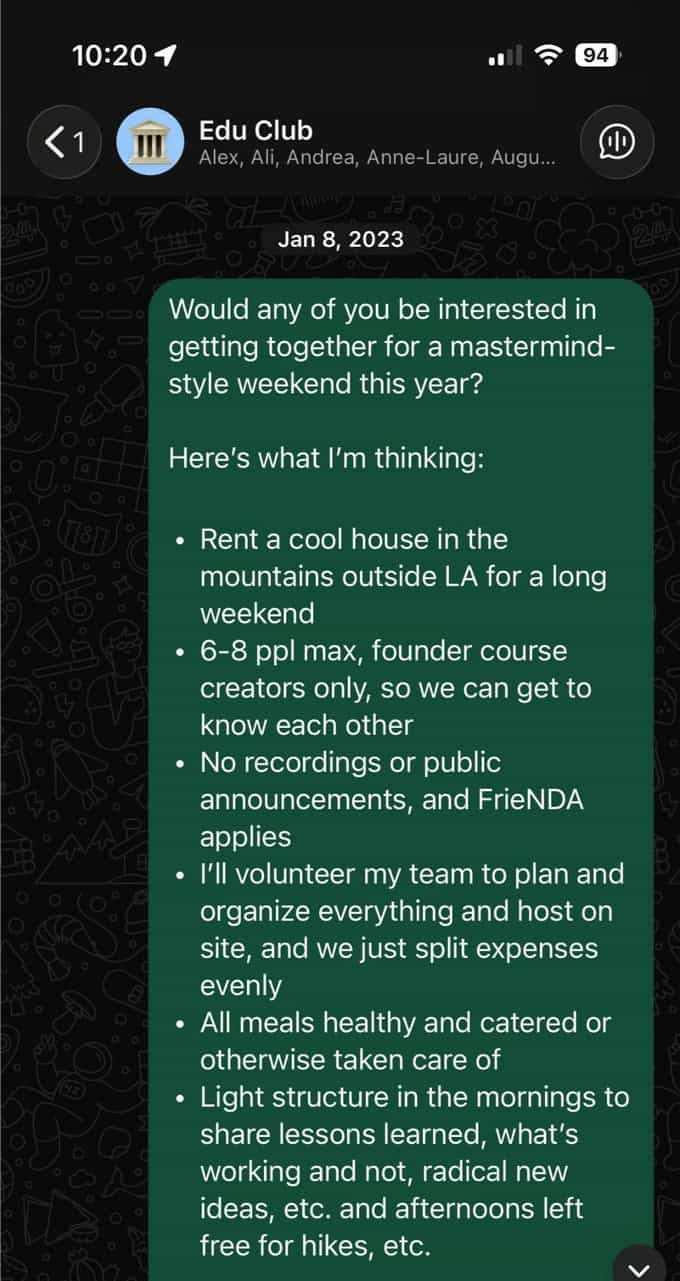
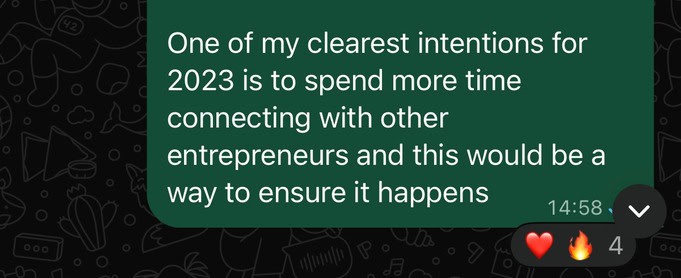
This message emerged from my annual review that year, completed just a couple days before, in which I decided I needed more community in my life after years of working in isolation during the pandemic.
To my utter surprise, about 10 people replied enthusiastically with some version of “I’m in!” The idea that a bunch of busy creators and entrepreneurs were willing to fly long distances and spend multiple days together in person was astounding to me.
We met for 3 days in person that spring for a gathering that would profoundly influence my future, my work, and my life. I’ve hosted four such retreats in the last four years, and they’ve led to a flowering of a community that has not only helped me reach my business goals but, far more importantly, surrounded me with a rich web of deeply meaningful friendships.
Here’s how others describe it in their own words:
I’m certain that looking back years from now, this community will be one of the most important and fulfilling things I’ve ever been a part of. The achievements and accolades will fade with time, but the friendships I’ve made there will endure.
I see a tremendous hunger in the world for shared, intimate human connection. Watching a YouTube video from the popular channel Yes Theory recently, I was struck to hear that they’re planning to offer “digital detox” retreats for their viewers in remote locations. That’s a remarkable statement on a platform that is designed to keep your eyeballs glued to the screen for as long as possible.
Listening to a recent episode of the Tim Ferriss podcast around the same time, again I was struck to hear Tim say that he’s no longer interested in pursuing solitary activities, such as archery. He mainly wants to spend time with people now, a notable admission from someone who practically invented the modern concept of individual self-optimization.
Everywhere I look, I see people yearning for a retreat from digital spaces, from the screens and streams that dominate our attention, from algorithms that stimulate but don’t satisfy. With the rise of AI, human connection is becoming more elusive, which means we have to be proactive in seeking it out. Human relationships can no longer be left to chance – we have to create intentional environments designed to cultivate them.
I’m writing this piece to share the lessons I’ve learned over the past four years in peer-to-peer community organizing. This is a role I never ever thought I’d play as a hardcore introvert. Yet for that very reason, it’s provoked some of the most amazing growth in me. I hope to inspire others to host similar retreats, as this kind of immersive, heart-centered experience is sorely missing from modern business culture.
I’ll offer a highly opinionated perspective on how and why to organize mastermind-style retreats, including the best way I’ve found to create a deep level of connection in a business context. Although this certainly isn’t the only way to run retreats, I’ve found that this approach leads to very meaningful experiences for attendees. Many of them have told me that these weekends are among the most impactful of their year, or even their career.
And if you want everything I’ve recommended below as a step-by-step playbook, share your email address, and we’ll send it to you for free.
What was missing
Before embarking on the process of starting my own mastermind, I spent a good 18 months studying existing options. But none of them seemed to fit what I was looking for.
First, because most of them seemed to have a “bro-y” atmosphere all about hustling, grinding, and winning at all costs, which I’m not interested in. I see my work as art, as science, and as education, and thus want to draw more on those fields than on the world of direct response marketing.
Such environments tend to not be very diverse, so you end up with a narrow set of viewpoints that have less insight to offer each other. I think it’s crucial that peer-to-peer learning include people from many cultural and professional backgrounds, since the solution to a thorny problem often lies outside the boundary of your domain.
Second, they all seemed quite expensive. $10,000–$20,000 is a common starting point, and they go up from there. I’m not opposed to anyone making a profit from their efforts, but what I notice is that these price points usually create a dynamic that undermines the purpose of a mastermind.
A mastermind-as–a–business tends to put everyone in the mindset of what they can gain or receive in benefits, rather than what they can contribute. A high price naturally increases turnover, as people come and go. And paradoxically, the highest credibility experts and authorities – the very people you’d most want to be in a mastermind with – aren’t usually willing to pay for the privilege. Instead, you get a lot of novices who have no other way to access such a group except by paying for it, the blind leading the blind.
Third, for a mastermind to be profitable, it has to reach a certain size. I once spoke with a professional event organizer who said that they needed to clear around $100,000–$120,000 in topline revenue for an event of this kind to be worth it. Which means you’d need 50 participants paying $2,000 each, which is much too big for the intimate atmosphere I was seeking. Or you could charge 25 people $4,000 each, but that starts to run into the issues above.
When a mastermind is a business, a lot of energy has to be spent marketing and promoting it, because it constantly needs to be growing and acquiring new members to replace the ones that leave. It has to come up with new services and programs and events to fuel that growth. All of this runs counter to the idea of a freely joined community that genuinely cares for each other and wants to see each other succeed over the long term.
And fourth, every mastermind I’ve seen tends to focus on a certain industry, topic, or professional identity. There are masterminds for authors, for marketers, for founders, for YouTubers, for women entrepreneurs. But I wanted an experience that forced me to transcend those siloed identities. That gave me exposure to people and ideas I didn’t even know I needed. That made me question my assumptions and borrow solutions from fields I wouldn’t otherwise encounter.
That cross-disciplinary borrowing has been one of the most powerful sources of insight for me, but it also introduces some challenges. It’s harder to explain what such an event is about, so you need to draw more on personal relationships with enough trust built up for people to make the leap anyway. It also requires more skilled facilitation, as you’ll have to build bridges between people so they can speak the same language.
For all these reasons, I decided I needed to start something of my own.
What to call it
I’ve tried various names, and have settled on “mastermind-style retreat” as the best.
“Mastermind” conveys that this is squarely a serious, professional, business-focused event, not just a casual hangout. While “retreat” also sets the expectation that it will be an informal, fun break from their normal routines.
We call our particular version the “Wholesome Mastermind,” a term coined by a previous attendee, because it signals that we want people to show up as humans, not their online personas.
How to host your own mastermind retreat
Here are my hard-won recommendations for how to organize your own mastermind-style retreat. You can also use our playbook, which contains all the advice you’ll read below in the form of checklists and templates.
The host
Everything begins with the host of the retreat. It’s paramount that there is someone in charge – with clear authority, a vision for how the event should go, and who is ultimately accountable for everything that happens.
A problem with some peer-to-peer events is that they’re too democratic. Too many decision makers means there’s effectively none, and the result is a muddled experience that lacks direction and focus.
Our retreats are hosted by my wife Lauren and I, which provides a healthy balance of masculine and feminine energy to our decisions. I often contribute a strategic lens, and she adds an atmosphere of care. We also encourage attendees to bring their spouses or partners if they work together in their business.
The dates
One of the first things you’ll do as the host is choose the dates for the retreat.
I’ve settled on 2 full days, plus a travel day on either end, as a great duration. Our typical schedule includes Thursday as an arrival day, with dinner that night being our first official gathering. Then we’re together all day Friday and Saturday, with Sunday as a departure day (or optionally, a collab day for recording interviews together).
This allows people to maintain almost their full workweek, from Monday to part of Thursday, while returning home on Sunday before the next workweek starts. But I’ve also seen other schedules work, and there’s a lot of flexibility here.
The spring and summer are ideal, as people tend to be in an open-ended and exploratory mindset, with most of the year remaining to apply what they learn.
Avoid long weekends, as many people make plans with family far in advance. This is a recurring theme I’ve found – if you want people with kids and families to be able to attend, you need to make special accommodations for them.
I recommend scheduling the event way further out than you might expect. If you want people to be able to travel long-distance to be there, and especially internationally, you’ll need to give them around 9-10 months’ notice to be safe. That allows them to build it into their travel plans before they have competing commitments.
The venue
I recommend a rural venue that is around 1-2 hours from a major airport. A rural setting encourages people to slow down, relax, and enter a more reflective mood far from their everyday work environment. But being within easy driving distance from an airport means you’re not wasting too much time in transit.
I specifically don’t recommend using a hotel, as the “corporate seminar” vibe is not the one you’re going for, and the presence of staff and other guests will be a distraction. You want to get attendees out of the mindset that they’re being waited on like customers. It should feel more like a group vacation among friends, where everyone is expected to pitch in and sacrifice a little comfort for the sake of camaraderie.
The ideal venue is a retreat center of some kind, with a collection of private and shared rooms clustered around a common area and meeting space. The meeting space is key – you’ll be spending much of your time there, so make sure it’s big enough to comfortably hold everyone, has good seating (we prefer couches and armchairs rather than chairs), and amenities like air conditioning, a place for coffee and snacks, a nearby bathroom, a whiteboard, and a projector and screen.
You could also use a small inn, but I recommend booking out the whole place so you can create an immersive experience. I’ve found the best group size for going deep with each other is around 15-20, which means most Airbnbs are out of the question. And you want to avoid having people stay offsite, as that necessitates more transport and coordination.
If you host a retreat repeatedly, I highly recommend doing it at the same location each time, as you’ll save tremendous time and effort by not having to make every decision anew. We’ve done it at the same place for three years running, and the planning now takes mere hours.
The food
I recommend catering all or most of the food on site, using fresh, organic, local ingredients. You could also have it prepared off site and brought in on the day of. This allows you to respect dietary restrictions and preferences, which you’ll likely have a lot of.
The quality of the food powerfully shapes how people feel at a visceral (as in, intestinal) level and therefore filters how they perceive everything. It determines whether they’re in a state – alert, focused, yet satisfied – to take in radical new possibilities. We spare no expense on the best local caterer, and work with them every year.
I don’t recommend eating out every meal. We tried this one year, and it’s hard to avoid food that is too rich and heavy and leaves everyone feeling lethargic. Outside meals also take too long and require too many transitions. By keeping people on site, you conserve a lot of time and minimize hassle.
Provide all the main meals, including light ones on the travel days on either end of the retreat, as some people will arrive early or stay late. And don’t forget a coffee and tea station in the mornings and healthy snacks in between for those who like to eat more often.
The activities
Consider what kinds of activities you want attendees to have access to, and which you don’t. There’s a fine balance between giving them options and dispersing their attention with random attractions.
The most important activities are forms of exercise. The venue we return to every year has a nearby hiking path through wetlands, a running track around the property’s perimeter, a paddle court, and a pool. Most people take advantage of at least one of these.
You can also schedule excursions to provide a change of scenery and atmosphere. We typically schedule one dinner out at a local restaurant in town on the first day, and on the second day, an afternoon hike along the nearby coast.
The facilitation
One of the most unexpectedly crucial moments of these retreats is the opening. Those first minutes shape everything that follows. Here’s the sequence we’ve settled on:
- A brief welcome from the host
- An orientation from the venue staff
- Connection-building exercises between attendees
The host should begin, because this entire experience and group has come together under their purview. Most of the attendees likely don’t know each other at this point, so the only thing binding the group together is the trust each of them has in the host.
For me, the main thing I want to convey in this welcome is vulnerability. I want to show up open-hearted and undefended, not performing my professional identity. When I do so, everyone else follows my lead and does the same, leading to a much warmer and more authentic time for all of us.
We’ll also typically introduce a “FrieNDA” at this point – asking everyone to agree that nothing said or done at the retreat should be shared externally without express consent, for privacy and confidentiality reasons. That is paired with a legal waiver indemnifying both the venue and the host, which we ask everyone to sign when they arrive on site.
Next, it’s important for the attendees to hear from the venue staff. They need to feel that they are welcome and that we’ve provided for their wants and needs. This could be the owner of the venue, or the manager, or the coordinator responsible for your event. They can explain how the property is laid out, which areas or activities are available, any rules or guidelines or requests, and who to talk to if they have an issue. We also ask the caterer to say a few words about the food they can expect.
And lastly, and most crucially, the best way to begin a mastermind retreat is through a series of exercises designed to intentionally build a sense of connection and vulnerability. The exercises we use are borrowed from The Art of Accomplishment and its programs, and include eye-gazing, reflective prompts, small group sharing, and others.
Most events leave human-to-human connection up to chance, hoping that it will arise naturally. It often does, but we’ve found that in about an hour and a half we can create a level of connection on day 1 that would typically take until day 3. Which means on the days that follow, we can chart new depths that never cease to surprise and delight us all.
Notice that we don’t typically include the standard “Go around the circle and introduce yourself” exercise, which I find everyone tends to secretly hate. Instead, I recommend having just the newcomers lead their own sessions (covered in more detail below), in which they’ll naturally say more about what they do, the context of their work or business, and what they’re working on now.
Otherwise, the facilitation needs are quite minimal the rest of the time – mostly keeping the agenda on track and everyone informed about the next meeting. This isn’t the kind of mastermind where a single personality is expected to be “on stage” the entire time. It’s a peer-to-peer, crowdsourced experience drawing solely on the knowledge in the room.
What is required from you as the host is a balance of authority and laissez-faire, between following the structure and allowing the flow, between taking care of people and trusting them to take care of themselves. It will require growth from you as a leader and facilitator, which is one of the best reasons to take it on. It’s a way of developing your leadership skills beyond the level you’d normally need in your day-to-day work. To become a leader of leaders, in a sense.
The agenda
I recommend keeping the days fairly open, rather than packing every last minute with plans. We typically do pre-scheduled sessions only in the mornings, leaving afternoons free with some optional activities, and then meet again in the evenings for dinner and a final evening session.
Here is a sample agenda for a typical day:
- 8 AM: Breakfast onsite
- 9 AM: Participant-led sessions (35-40 min. each)
- 12:30 PM: Lunch onsite
- Afternoon: Conversations, walks or hikes, pool or jacuzzi time, relaxing, breathwork, and free time
- 5:30 PM: Dinner onsite
- 7:30 PM: Participant-led sessions (35-40 min. each)
Here are the kinds of topics we’ll typically dedicate the participant-led sessions to, each one led by an attendee, not an outside speaker:
- Book writing and publishing
- YouTube, Instagram, LinkedIn, etc
- Hiring and managing teams
- Courses and cohorts
- Decision-making and strategy
- B2B training & consulting
- Community management and memberships
- Subscriptions/recurring revenue
- AI
- Craft & creative process
- Storytelling & narrative
- Content repurposing
- Pricing & packaging
- Product ladders & ascension
- Marketing funnels
- Sponsorships & affiliates
- Licensing & certification
- Reducing founder dependency
- Speaking
- Newsletter & email lists
- Life transitions and reinventing your work across eras
- Long-term IP and asset ownership
- Purpose, legacy, and succession
- Burnout and work-life balance
- Money psychology and “enough”
- Balancing creative work with parenting/marriage
The afternoons can be spent napping, resting, journaling, walking, exercising, or having smaller ad hoc conversations 1-on-1 or in small groups. While an agenda is helpful so people know what to expect, some of the best moments tend to happen in these informal moments, around meals or campfires, on walks, etc., so leave plenty of time for such serendipitous moments.
It’s wise to begin the very first session with an intention-setting exercise, and to close the final one by giving people time to identify their main takeaways. These intentional bookends reinforce the shape and structure of the experience in their minds.
It also helps to use a variety of formats for the sessions, not just slide presentations. For example:
- Short lightning rounds (such as the “Ignite” format of timed, rapid-fire presentations)
- Moderated group discussion (led by someone with experience on a topic, but drawing on everyone’s contributions)
- Hot seat real-time coaching (having the presenter interact with someone and coaching them through a challenge)
- Facilitated roundtable or panel (several people who are most experienced in a domain talking through their lessons learned)
I’ve found that around 30–45 minutes is the best duration for sessions for a group of 20 people, as it allows enough time to explore a subject, as well as answer questions. This means that a typical morning can accommodate around 3-4 of these sessions, from about 9 am to 12:30 pm, and the evening another 2–3. That’s 5–7 total sessions per day, or 10-14 for the full retreat, which means that most attendees get to lead a session.
This kind of mastermind can be quite an intense experience for many people, which is why it’s so important to leave space for integration and rest. It’s not mainly the volume of information that is challenging, but its richness and diversity. We’re not used to pivoting between wildly different topics from super high-trust people within a tight span of time. It’s as if the information gets piped directly into your nervous system across multiple senses.
I believe that what’s happening during these retreats is not just that we’re getting exposed to new information, but new paradigms, new perspectives, and new worldlines in the multiverse. We’re being introduced to entirely new possibilities for the direction our work and lives could go, with flesh-and-blood models of what that might look like standing right in front of us, ready to answer our questions.
Making invites
For me, this has been the most challenging, but also most interesting aspect of hosting these retreats. Nothing else can happen unless people say yes to your invitation, so this is the crux of the entire endeavor.
The single best criterion I’ve found for who to invite is, “Who do I admire and want to learn from?” This selects for people who’ve accomplished something in at least one domain that I find impressive and want to learn about. But it also filters out those who achieved their accomplishments at the cost of their integrity, reputation, or relationships. I don’t tend to admire people who’ve burned bridges or become a pale shell of a human to get where they are. This also ensures I have very nice things to say about them to the other attendees.
The 37 people who’ve attended one of our retreats so far tend to be highly open-minded and open-hearted, usually with an existing interest in personal development. They need to be willing to encounter radically new ideas and points of view in a spirit of curiosity. They tend to be highly accomplished, but also humble in the face of everything they don’t yet know. They’re more interested in learning than in brandishing their own ego, in other words. Our attendees mostly come from the intersection of creativity and business, including content creators, authors, YouTubers, podcasters, course creators, and other educational businesses.
This also points to why paid masterminds are so problematic. If the bar to entry is simply being able to pay, you’re not going to have your true peers there. You’re going to have customers who are more focused on imitating you than connecting with each other.
One thing to note is that you don’t necessarily want to invite your closest existing friends. There are other venues for hanging out with them, such as a group vacation. The purpose of a mastermind is to go beyond your existing first-order connections; to elevate the quality of conversations you’re having; to spend a concentrated amount of time with someone and form a relationship that would probably never otherwise be possible.
You may very well become friends, and I count many dear friends among our attendees, but I think the main purpose of a retreat like this one has to be about advancing your work, business, mission, message, or impact in the world. Otherwise, the value of the experience gets diluted.
In other words, I think it’s crucial that the host center their own desires, needs, goals, and interests in the curation of the attendees. They should design the experience to fuel their own growth as a person, as a leader, and as a businessperson. That may seem contrary to the peer-to-peer ethos, but I don’t think it is. It requires a lot of time and effort to host a mastermind, which is time and effort you could have spent building your business or making money. Instead, you’re being paid in terms of knowledge and insight. Otherwise, you’re going to feel like you’re only servicing others’ needs, which eventually leads to resentment.
All this means that making invites requires significant effort and careful though. Your best friend might say yes to a vague request, but someone three hops away in your network, who you’ve never met in person and who only knows you by reputation, won’t. The trick is to be highly strategic and appeal to their rational mind, without losing your warmth and humanity along the way.
I’ve found that you almost always need some sort of existing connection to a person to have a chance of them accepting your invite: maybe you move in the same circles and know each other by reputation; or have been part of the same event or conference; or have interacted on social media in some way; or have been introduced by a mutual acquaintance.
There are only so many people you’re connected to in that way, so it’s helpful to have some kind of broader virtual community that you can invite people into first in a low-risk way. For us, that’s been two WhatsApp groups that I started around 2022, when I was launching my book, and realized that I wanted to stay in touch with a lot of the people I was meeting.
One group chat is for authors, and the other is for course creators, which is a nice balance of those who know how to acquire attention and those who know how to monetize it. These groups have around 100 members combined, and almost everyone who’s attended a retreat first joined one of these groups as an intermediate step.
I think having such a group chat goes a long way to allow newcomers to “get the vibe,” see the quality of the people around them and the knowledge they’re sharing, and want to go deeper and spend time in person. The only way to join is by personal invitation from me, or being personally referred by someone else already in the group, so these groups grow very slowly but with a high level of trust.
A central principle in deciding who to invite is maximizing diversity along every dimension I can think of: culturally, linguistically, geographically, age-wise. Not because of a corporate diversity initiative, but because the entire point of a mastermind is to gain access to new points of view, and new points of view only come from those with different backgrounds and experiences. I take care to have about 50% women, as these kinds of environments tend to be dominated by men otherwise. I try to include a variety of professional backgrounds and types of businesses, while maintaining enough shared context that we’re interested in the same subjects.
I’ve found that achieving this kind of diversity requires intentional effort, not just a vague intention. A given woman is maybe half as likely to say yes to an invite as a man, and I completely understand why – they’re being asked by an Internet stranger to come hang out for three days in person. So I have to put in additional effort to explain what the event is about, to convey how it will help them, and to accommodate any special needs or concerns they have.
Once you’ve decided who you want to be there, it’s imperative that you craft a highly personal, thoughtfully written message graciously inviting them to join your mastermind retreat. It absolutely needs to come from you, the host, and I recommend a tone that isn’t too formal or “professional,” as you’re already starting to set the tone of the event with this message.
Tell them what the event is about and why you’re doing it, who’s already confirmed, what the topics or sessions will be on, and basic details on the venue, sleeping arrangements, and travel time, and how the days will flow. Make it clear how and why this will be a highly valuable way to spend their time, as they’re likely weighing it against multiple other options.
When crafting this message, you have to remember that this is a major ask you’re making. Most emails ask for a few minutes of time or to appear on an hour-long podcast at most. This one is asking them to pack up and fly across the country or world to spend multiple days of their valuable time with people they’ve mostly never met. From their perspective, it’s risky – how do they know this won’t be a waste of time (at best), or even endanger them (at worst)?
Thus the commitment you’re asking them to make isn’t to be taken lightly. Think of it as them gifting you their time and attention, which is in high demand. They’re trusting you as the host to be the bridge to this new world, to look out for their interests and intervene if anything goes wrong.
Lastly, I typically reserve about 5 out of 20 spots in each retreat for newcomers. That ensures there’s a healthy inflow of new ideas, while also preserving the culture that’s been built and maintaining continuity across the years, which is how true friendships are built.
The finances
My recommendation is to split all retreat costs equally across all attendees. With one exception: the retreat host (and their staff, if present) should have their costs covered by the rest of the group.
That way there’s no profit, which means no one is questioning who is reaping a windfall behind the scenes. It makes people feel they’re on an equal playing field as peers, not above or below anyone else, which tends to inspire a spirit of contribution and generosity. That also means the host doesn’t feel like they have sole responsibility for the entire event. Everyone is responsible for making it great.
This non-profit model also helps keep costs in check generally, as no one wants to increase everyone else’s expenses. And most of all, it results in a total cost per person that is far less than most masterminds, which makes everyone feel that they’re getting a ton of value.
The total cost for around 20 people is usually around $30,000 all included, which comes out to around $1,700–$2,000 per person. That’s a pittance compared to competing masterminds I’ve seen. Some masterminds have the entire bill footed by a host or sponsor, but I don’t like that either, as it tends to make people feel indebted to that person and not have skin in the game.
Ironically, despite the mastermind itself not generating a profit, I personally believe it is one of the most profitable things I’ve ever done, considering all the ideas, insights, strategies, tactics, partnerships, and alliances that have come out of it.
I recommend sharing a full accounting of all retreat costs in a spirit of transparency, answering any questions, and then sending each person an invoice for their share in case they want to expense it.
Preparation and planning
So you’ve made your invites, they’ve been accepted, and you’re getting ready for the retreat itself.
The first thing to keep in mind is that the people you’ve invited are VIPs. Their time and attention are in demand, and they don’t have much to spare. Furthermore, they get a ton of inbound requests and communication, so they have to be selective about what they even respond to.
It’s for that reason that I tend to do everything I can to minimize the amount of pre-work I ask of attendees. I send the minimum number of emails, make them very clear with a straightforward ask, and collect all the info I need from them via a short Google Form. I don’t tend to follow up much – if they stop responding, I assume they’re out after one reminder. I don’t want to get into the habit of having to follow up on everything.
I also don’t create a bunch of obligations for them after the retreat. There’s not really anything for them to do after it’s over besides pay their remaining invoice and, optionally, share their pictures. I like the idea that the retreat is a complete container within itself, and not part of an ongoing commitment that they’re even subtly expected to sign up for. I think that makes the experience clean.
Communicate all event details in a single shared doc, such as a Google Doc or Notion page. This “one source of truth” gives everyone a single place to look when they need to know something. I also recommend creating a dedicated WhatsApp group for attendees to talk to each other beforehand and stay in touch afterwards. They can customize their notifications based on the level of exposure they want to the conversations happening there throughout the rest of the year.
Include in the doc who the host is, the phone numbers of key people, official start and end times, the basic agenda, weather and temperature expectations for which clothes to pack, food details and dietary options, other activities available, a range for the total estimated cost per person, transportation options, photos of the venue, and rooming details.
It’s a good idea to collect dietary preferences and restrictions from attendees beforehand to pass along to the caterer. Also collect attendees’ planned arrival and departure times, and include them in the planning doc, so you can coordinate rides to and from the airport.
For supplies, you’ll want flip charts, whiteboards, a projector and screen, markers, pens and paper, and post-its. Providing notebooks to attendees is a nice extra touch.
The first time you host a retreat like this, you’ll probably do it on your own. But that’s not ideal for being able to be present and participate fully. Like when you host a big dinner at your home, it likely means you’ll spend much of the time running around and fighting fires.
The ideal setup is to have two support roles: one on your own team, and one person who works for the venue. That way you always have two people, one internal and one external, to rely on. Their goal is to allow you, the host, to remain fully present and focused on what’s happening during sessions and conversations.
Why we do this
As the years have passed, the Wholesome Mastermind has become one of the most treasured, rewarding parts of my life. It’s a standing commitment each year to intentionally go deep with a group of creator friends, in a way that’s totally distinct from normal business culture.
My wife, Lauren, and I have found that there’s no other space in our lives like this one – where we’re free to bring our full intellectual, creative, emotional, and vulnerable selves to the table, and be met there by others doing the same. It’s made me realize the extent to which we compartmentalize ourselves, presenting only the facet that’s acceptable or appropriate in any given social scene.
When I think about what entrepreneurs need, I don’t think of any technological tool, business tactic, conceptual framework, or disruptive innovation. I think of rooms like this one, where we are free to show up as humans, and to bare our souls that others may truly see us.
The more AI reshapes society, the more important such spaces will become. They will be havens of humanity in an algorithmic landscape that’s designed to atomize and isolate us. They will be a place to cultivate human relationships as AI mediates more and more of our interactions.
I hope the lessons I’ve shared here inspire you to host a mastermind-style retreat of your own. It’s not easy, but I can promise you that it will be among the most worthy, fulfilling endeavors you can take on. And don’t forget to share your photos and stories with us if you do.
Follow us for the latest updates and insights around productivity and Building a Second Brain on X, Facebook, Instagram, LinkedIn, and YouTube. And if you’re ready to start building your Second Brain, get the book and learn the proven method to organize your digital life and unlock your creative potential.
- Posted in Coaching, Entrepreneurship, Personal growth
- On
- BY Tiago Forte