
I’m incredibly excited to inaugurate a new project I’m calling Operation Gallavant: a multi-month family road trip we’re planning on taking down the length of Central and South America.
This is something I’ve wanted to do for many years. Ever since I was a child, we’d regularly visit my Brazilian family via a 12-hour flight from Los Angeles. Looking at the map, I would always naively wonder, “Why don’t we just drive to São Paulo instead of flying?”
I would eventually learn that it is a formidable journey across rough roads, the towering Andes mountains, dozens of border checkpoints, every kind of climate and topography, and of course, the infamous Darién Gap separating Panama from Colombia.
And yet, over the years, I’ve come across stories of people who did it anyway. In his books, Investment Biker and Adventure Capitalist, renowned investor Jim Rogers documented his round-the-world journeys on a motorcycle and car, respectively. I read them in my early 20s and was captivated by his wild accounts of exploration. I didn’t know it was an option to go so off-script from the standard template for international travel – short trips, by plane, to specific locations.
So in my early 20s I wrote down as one of my earliest life goals: “Travel around the world (every continent) by car in one trip with one other person by age 30.” It didn’t happen in my 20s, or even in my 30s, but I’m determined to make it happen in my 40s!
I’m scaling down that original ambition to something more manageable: rather than taking on the world, we’ll cross the entirety of Latin America, from Mexico to Argentina, and then possibly north to Brazil. But I’m also scaling up my original ambition in a way, by taking our family of three young kids along for the ride.
The rise of overlanding
I’ve been inspired by the modern phenomenon of “overlanding,” which involves long-term, long-distance travel by car. It’s a fusion of elements from classic RV touring, #vanlife, off-roading, glamping, and remote work – a self-reliant way of exploring off the beaten path in a specialized vehicle for a sustained amount of time.
Books like Following the Sun by Margaret Bensfield Sullivan and Overlanding the Americas by Graeme Robert Bell contain vivid, detailed accounts of families on similar adventures. These self-published travelogues are full of lessons and stories I’ve taken notes on to inform our own plans.
Overlanding has been popular for decades in Europe and Australia, but it exploded in popularity in the U.S. during the COVID-19 pandemic, since it was an accessible way to travel and explore while maintaining social distancing.
There’s now a specialized overlanding industry selling things like rooftop pop-up tents for sleeping, portable fridges, solar panels, kitchenettes, water filters, and portable showers. Outfitting the car is going to be half the fun, I suspect, involving off-road tires, suspension lift kits, and of course, four-wheel drive.
All this specialized gear and the newfound popularity of overlanding will make this adventure more feasible, as there are more people doing it than before. It’s become so much more realistic to travel this way because of mobile internet, credit cards, and Airbnb. And the fact that we speak Spanish and Portuguese fluently and have lots of experience living in Latin America helps tremendously too.
I love the idea of long-distance driving specifically because of everything it offers beyond the standard fly-in-and-out vacation. I want to go very slowly, following our curiosity rather than sticking rigidly to a pre-planned itinerary. I want to avoid the tourist traps and learn about how people live across this far-flung continent. I want to see how regions connect and how the language changes as you move across the landscape.
I imagine we’ll drive in “sprints” of no more than 1-2 days at a time, stopping to explore a city, town, or region for days at a time. That will allow us to take our time, immerse ourselves in the local culture, and maybe even get some writing in here and there (with some help from Starlink).
Based on my initial research, this route can be driven in as little as 6 weeks, but with all stops and the slow pace of 3 young kids, I think it will take more like 3-5 months. Which means I’ll need to take a sabbatical from work to make it happen.
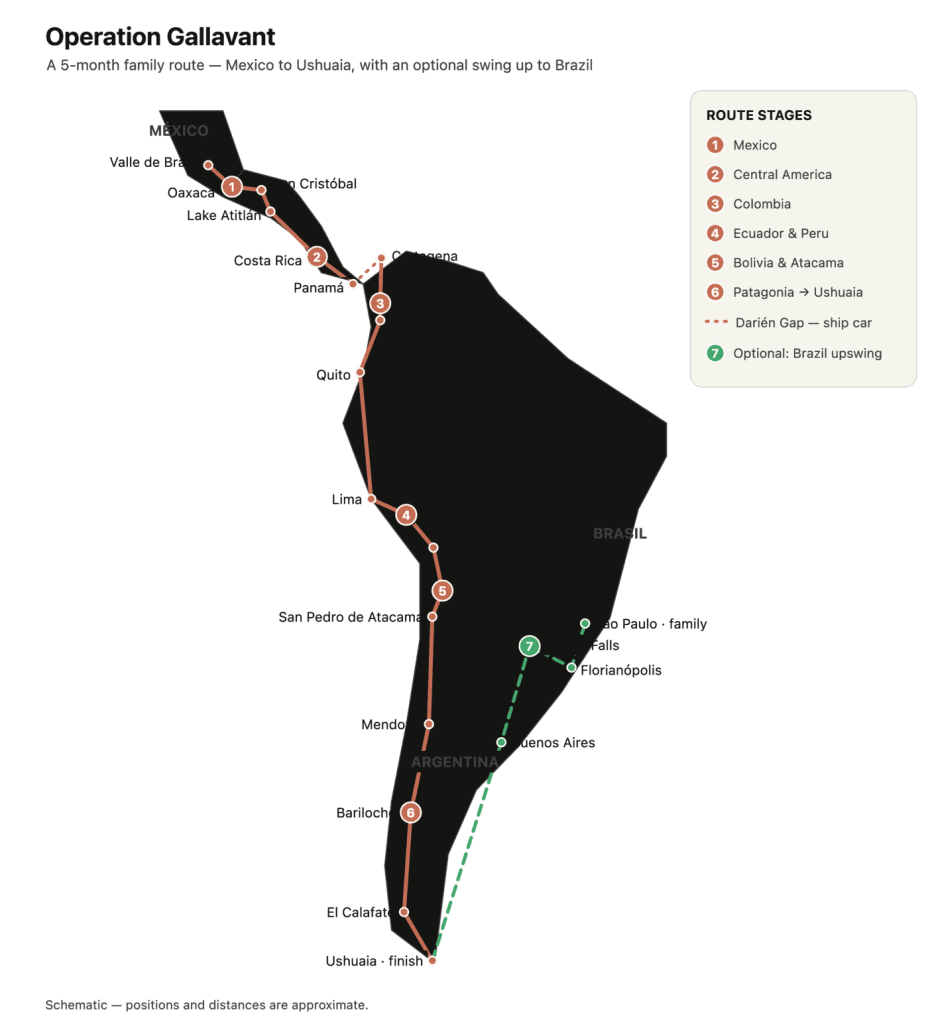
I don’t know exactly which route we’ll take, whether we’ll depart from our place in Mexico or from Long Beach, and how long it will take. I don’t even know when we’ll do this trip, but I suspect we’ll need to flex and adapt our planning in response to where the kids are at, what they’re ready for and interested in, and how well we withstand the rigors of overlanding as a family.
Escaping the culture of safetyism
One of the main reasons we left the U.S. was to escape the toxic culture of “safetyism” that has taken hold there in recent decades – the impulse to eradicate every form of risk or discomfort that might affect our children at all costs.
As Steve Magness writes in The Cost of Safetyism, many forms of childhood independence have been curtailed in our time:
- 84% of 11-year-olds aren’t allowed to leave their street, and 53% aren’t even allowed to leave their front yard
- 92% of 14-year-olds aren’t allowed to leave their neighborhood, and 55% can’t leave their street
- Only 50% of parents would let a 9–11-year-old find an item at the store while they shopped in another aisle
- Only 15% would let them trick-or-treat without an adult
- Only 20% of 5-8-year-olds are allowed to prepare their own snack
Kids don’t roam nearly as far from home, even in their own neighborhood, but also aren’t even able to make their own lunches, or walk down a different aisle of the store. Nearly every form of childhood independence and autonomy seems to be in precipitous decline.
On the surface, safetyism looks like caring, attentive parenting. But as Magness notes, what it really is is avoidant parenting. It’s the fear-based, overprotective belief that if you shield your kids from any source of pain, that means they’ll grow up to be healthy, thriving adults.
I think this is catastrophically wrong, and that people aren’t talking about it enough. The whole purpose of childhood is to mess up, to skin your knees, to run up against the limits of reality and feel reality push back. It’s what children are made for. Without those bumps and bruises, they don’t learn self-reliance, resilience, or self-confidence. Without conflict and stress, they have no reason to develop emotional regulation or their executive function.
And the research bears this out: a 2024 meta-analysis of 52 studies on overparenting found that across cultures and income levels, overparenting predicts higher rates of depression, anxiety, and internalizing symptoms in children. In my opinion, other negative trends among children like screen time and declining mental health are largely side effects of this deeper underlying trend, which transcends any particular technology.
The hard part about fighting rampant safetyism is that you can’t really expose your child to risk or pain on purpose, just for the sake of it. You can’t drive your kids around without a 12-point carseat that looks like it could survive a nuclear explosion, even though they do that all over the world. Someone might call child protective services if you let your kid so much as walk around the block by themselves. When you’re at the playground, and your kid tries crossing the monkey bars, it’s hard to resist the cultural norm of hovering to catch them if they fall. You’ll seem perverse if you don’t take what parenting culture perceives as the “expected” precautions.
This is where overseas travel is so helpful: you take on more risk, but it’s for a larger purpose. You’re being rewarded for taking that risk with benefits like cultural fluency and personal growth. And it’s manageable, as every culture has built-in ways of managing its own risks.
I think the most appalling side effect of overprotective parenting is that it teaches kids that the world is fundamentally a dangerous place, and that they’re not capable of navigating it. That’s the message they get every time we add another safety pad, create another rule, or cancel a sleepover. It’s as if we’ve designed our society to cultivate learned helplessness in our children.
Extended time overseas has been the most powerful antidote to that learned helplessness I’ve ever encountered.
Why we’re doing this
I’ve run this idea by a few people already, and the immediate question is always “But…why?” At this moment, before any real concrete plans have been put in place, I want to focus on this big picture question.
The fundamental reason is to learn, grow, and become closer as a family through discovering the wonders of Latin America. We’ve accomplished that partially by living in Mexico, but there’s still something missing for me: the adventure of travel.
The purpose of Operation Gallavant is to expose our kids to the wider world. To instill in them a sense of self-determination and a lifelong love of learning. To provoke their curiosity and wonder and teach them that the world is an endlessly fascinating and (mostly) welcoming place. Children are natural learners, as Peter Gray writes in Free to Learn, and I want to take them out into the real world where they’re free to learn from direct experience.
I was raised this way, with multiple cultural influences intersecting in our household from Brazil, the Philippines, and other countries. My parents always prioritized long-term travel, and we visited a dozen countries growing up. When I was 14, we moved to a small mountain town in Brazil and lived there for a year, an incredibly formative experience that still impacts me to this day.
My father once said, “It’s important to be able to see things from several points of view. It makes you safer and harder to deceive.” And I’ve seen that play out across every aspect of my life. As long as I have access to different perspectives, I can always find a way around or through any obstacle. I am indeed harder to deceive, not only at the level of pickpockets on the street, but more importantly, at the level of false narratives about what matters in life.
I see traveling as the ultimate classroom. It teaches you patience, since you’re never in control of the bus schedule or flight departure. It teaches you resilience, since you inevitably come up against frustrations and disappointments. It teaches open-mindedness, since every conversation, every street, every meal is a chance to be surprised. It teaches you to see through the eyes of others, as you encounter new ways of thinking, new belief systems, and the inevitable fact that there isn’t one right way to live. It incorporates elements from history, language, science, technology, psychology, politics, international relations, and geography. It teaches street smarts and practical skills, from navigating transit systems to roadside car repair to understanding maps.
I also want to do this while we can. I’ve talked to many people who want to attempt something similar, but there is always a reason they can’t: a child with a chronic condition, aging parents who need care, a job with an in-office requirement, financial insecurity, or any one of a number of other tethers. As long as we have the option to go, I want to take advantage of it, because the window could close at any time. There’s a window of time with my kids’ ages – my eldest son will eventually be in high school, with all his own desires and plans and dreams, which might make such a trip harder. I also have my own window of opportunity: I’m down to undertake a physically taxing trip like this in my 40s, but I doubt I’ll want to in my 50s. There’s really only a single decade of my life when this is possible.
Even now, I find that this commitment is starting to shape our decisions. On the work front, I’ll need to take a sabbatical, so we’re already starting to structure our flagship program, The AI Second Brain, to be taught by facilitators whom we’ll train and coach. And on the financial front, we’ll need our finances to be secure to feel confident leaving for so long, and are shifting our savings and investments to be more conservative as a result. A looming decision that isn’t too far off is whether we keep our home in Mexico and depart from here, leaving the house empty for months, or pack up and move back to Long Beach first and then leave from there.
Not only do I think we’ll survive this sabbatical as a business, I’m beginning to think it may be the best forcing function for growth. The biggest liability for Forte Labs has always been its dependence on me. But as long as I’m around and involved in day-to-day affairs, it’s hard to ever truly lessen that dependence. With months away, I’ll have no choice but to delegate the core functions of the business, including teaching, and the team will have no choice but to step up to a new level of leadership. I’m excited to see what changes this direction inspires before we even leave.
I’ve also had a couple of people question whether this is a wise move in the face of supposedly imminent AGI (Artificial General Intelligence). Can I really afford to take so much time off work when there’s so much at stake? First of all, I don’t believe there’s going to be a single moment when we gloriously ascend into the singularity (when AI surpasses human intelligence, allowing it to autonomously redesign and improve itself). That attitude is based on misconceptions about the nature of intelligence and its relationship to the modern world. AI will take many decades to ripple through society. We won’t see the end of it in our lifetimes. There probably won’t be an end to it.
And even if AGI is imminent and about to irrevocably transform the world, then my attitude is, why don’t I see the world before it does? When uncertainty rises, your horizon should become shorter-term. Why invest in a far-off future that may never come? It’s better to experience the life you have now in the present and savor the fruits you know are available. This is something I’ve learned from Latino culture: when the future is unclear, live in the moment.
I’m even curious to see whether AI might make a trip like this easier. Whether for trip planning, research, managing logistics, or streamlining translation and communication. We should have fully autonomous agents by then. I wonder if I can task one as a full-time travel assistant?
In any case, I think the greatest challenges will be interpersonal. I know we have a lot to learn on this front, as we don’t yet have much experience road-tripping as a family. When we welcomed our third child into the family, we spent our first weekend together in Mexico City. It was…challenging. There’s a whole new set of muscles that Lauren and I, as well as the kids, will need to learn to be able to spend so much unstructured time together and face the situations that will arise. But I’m looking forward to that as well.
They say that “Life is all about the journey,” but I think it’s more accurate to say that “Life is all about the journeys.” Sitting in your house, going through the same routine, doesn’t automatically give you experience points. It just makes time pass faster and faster in a blur. What makes an exciting and fulfilling life is the specific journeys you undertake, whether intellectual journeys, relationship journeys, or overlanding journeys like this one. At the deepest level, I’m very curious to see what kind of personal growth this trip provokes. Moving to Mexico and to a small town was a necessary first step to start unplugging from a work-centric lifestyle, but the next frontier is to hit the road.
The main reason I’m announcing this publicly is to ask for ideas and advice:
- Do you have a mindset, principle, or strategy that you’ve used to travel long-term successfully with small children?
- Do you have any packing tips or overlanding hacks to share?
- Are there underrated places, sites, regions, or activities you can recommend anywhere along our planned route?
Please send them to me at [email protected] with the subject line “Operation Gallavant,” and I’ll compile and share the best of them.
Follow us for the latest updates and insights around productivity and Building a Second Brain on X, Facebook, Instagram, LinkedIn, and YouTube. And if you’re ready to start building your Second Brain, get the book and learn the proven method to organize your digital life and unlock your creative potential.
- Posted in Digital nomads, Personal growth
- On
- BY Tiago Forte