
At the start of 2025, I dubbed this “The Year of Profitability,” and now that it’s come to a close, I can say we successfully fulfilled that intention.
We ended the year with 2.15M in gross revenue, and $650,000 in net profit, for a 30% gross margin. That’s our second-best year ever as a business! Behind only 2021 at the peak of the pandemic.
There were 3 main things we did to make it happen:
- Launched a high-ticket, high-margin program that tapped into the surge in demand for AI training among business owners
- Kept the team intentionally small and lean, with no new hires
- Continued cultivating existing revenue sources, such as the Second Brain Membership
Some of the other wins from the year include:
- Launched the official Second Brain Notion Template, which sold over 2,350 copies this year (update coming soon)
- Grew our Circle community to over 13k members and launched our BASB app for easier access
- Doubled our publishing cadence to weekly on our YouTube channel, which grew to 373k subscribers and received over 4.8M views in 2025 (consuming a mind-blowing 48 years of combined viewing time)
- Hosted the seventh edition of our Annual Review program, including beta access to the manuscript of my upcoming book, Life in Perspective
- Reached 400,000 lifetime sales of my book Building a Second Brain, which is still in the process of being released in more languages and countries
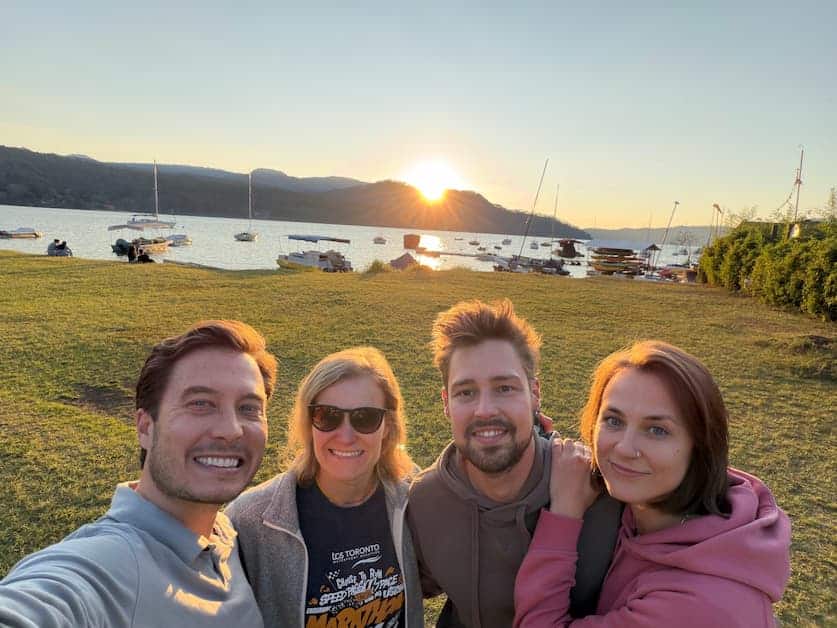
I think what makes me especially proud of these milestones is that we did it all with such a small team. We recently got together for our annual retreat in the town where I live in Mexico (missing Rebecca and Sasa, unfortunately):
In this review, I’ll share the full story behind our financial turnaround – from YouTube’s explosive growth to the unexpected success and subsequent wind-down of my involvement in Second Brain Enterprise. I’ll also cover the challenges we faced across our ecosystem, our pivot toward AI for 2026, and some major personal milestones, including becoming a gym rat and preparing for baby number three.
Keep reading or watch the video version of this annual review:
YouTube
More than 3 years after I decided to make Forte Labs a YouTube-first company, our YouTube efforts really came into their own in 2025.
We had our first massively viral video, on Google’s NotebookLM, breaking the 1M view mark for the first time. This one video led to 31,000 new subscribers and a staggering 145,000 hours of watch time.
But YouTube came into its own not just in terms of attracting attention, which it’s been doing for awhile, but as a sales channel. Most of the $1.5M in sales we made from our new AI program, Second Brain Enterprise, came from just a handful of videos there, and we proved that people will make major purchases directly off the platform.
We are now clearly a YouTube-first business, with 53% of our audience growth and 36% of customer discovery happening there. I’m so happy that I decided back in 2022 to pursue it as our main platform, as we wouldn’t have much of a business right now if we hadn’t.
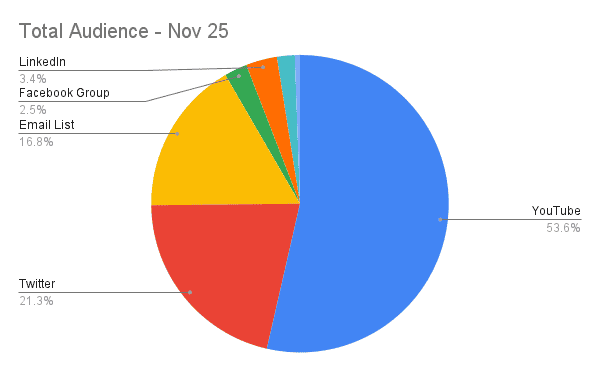
This graph tracking our following across all our platforms shows how YouTube (in red) is in a league of its own when it comes to attracting new followers, due to the power of the algorithm in finding new audiences.
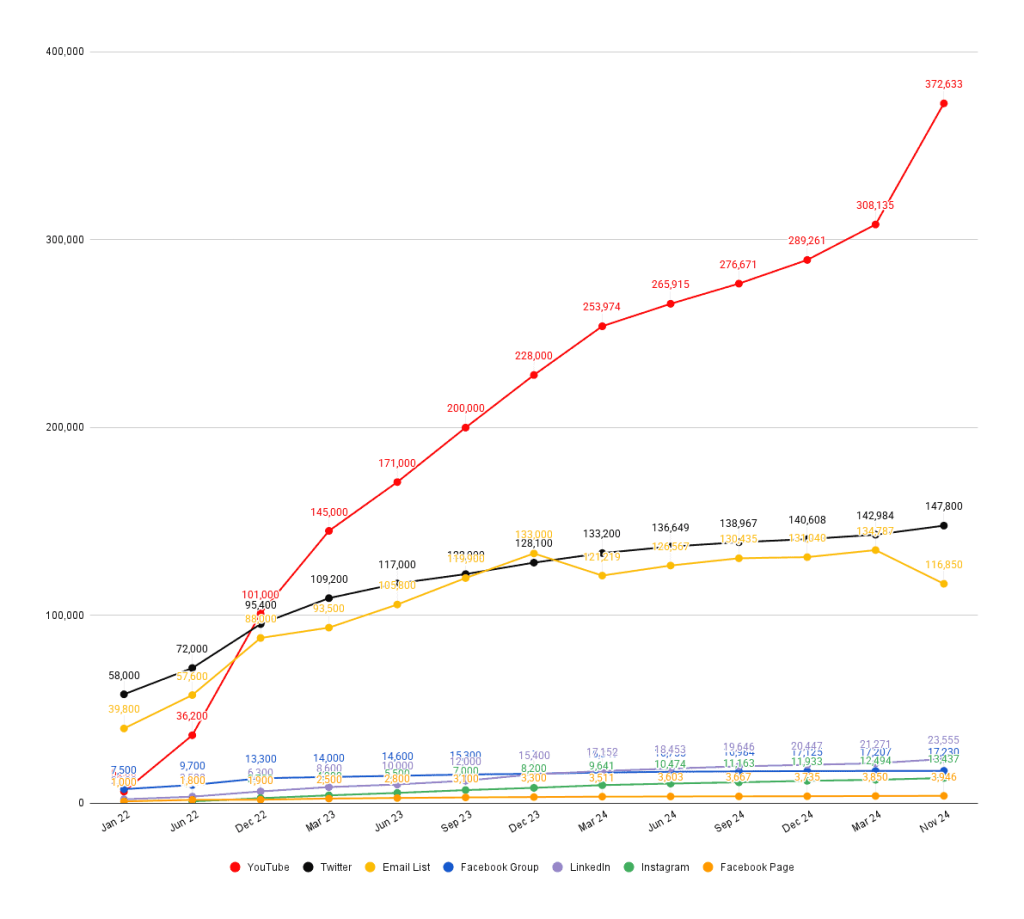
Despite all these positive signals, there were also some negative ones as well:
- Our average clickthrough rate (a measure of how many people see our thumbnails and decide to click on them) was 4.3%, which is low compared to a target benchmark for best-in-class educational channels of around 8%.
- Although we gained a lot of subscribers, the percentage of returning viewers (which I’m learning is far more important than subscribers) was down 27% due to our changed focus on B2B content that wasn’t relevant to most subscribers.
- Average Percentage Viewed, a measure of how long people watch on average, was down slightly from 24% to 20% (this was partly due to our videos becoming quite a bit longer, but is also worrisome as it’s one of the main numbers that the algorithm looks for).
Most of these negative signals can be attributed to a pivot we made mid-year to B2B-centric AI topics, to support the launch of our Second Brain Enterprise program. That sharp shift in focus led to a lot of churn, confusion, and aversion from our typical viewership. More on that below.
In light of all this, we’re doubling down on YouTube yet again and strengthening the foundation for next year by increasing our publishing cadence to weekly as of this past October. In 2024, we released 31 videos, in 2025 it was 37, and in 2026 we’re aiming for around 46-48. It’s taken us several years to slowly build up the team and the capability to move at this speed, but I’m expecting the higher cadence to give us more opportunities to learn, iterate, and double down on what’s working.
Website, blog, and email list
The picture for our older ecosystem – which I think of as our website, blog, and email list working together – is less positive.
Part of it is that I’m writing much less on the blog, having released only 21 articles in 2025. That’s partly because I have less time overall since becoming a father, and partly because any concentrated writing time I do have goes to writing books now.
But a major external factor is that the landscape of online attention is rapidly changing. Blogs are all but dying in the face of competition from algorithmic platforms and Substack. And SEO is being undermined by LLMs that stop people from even searching for things in the first place by giving them the straight up answer.
The blog still attracted 952k visits in 2025, though that is 25% less than the year before. The U.S. accounts for 38% of our website visitors, but we saw an 80% increase from China, which I assume is due to my books being released there. LLMs already account for 3.5% of all visitors, despite the fact that we haven’t done anything to optimize or encourage that. I can see in the coming years AI coming to dominate how people find content online.
Lead magnets are also becoming much less effective, I assume because AI now allows you to create something similar in seconds. Every single source of traffic to our website shows a 40-94% decline in subscription rates, regardless of whether traffic went up or down. This means that organic email subscriptions are way down over the last few years: from 237 per day in 2022 to 115 per day in 2025, a 50% drop. We’re becoming more dependent on “events” such as webinars, viral YT videos, and partnerships and having to work harder to convince people to join our newsletter.
Despite those headwinds, 63k people subscribed to our newsletter this year, representing a 4.23% subscription rate. Once they’re there, engagement is strong, with 48.6% open rates and 3.8% click rates.
Incredibly, in 2025 the average time someone was on our email list before purchasing was only 3 days, which reveals that they don’t necessarily need a lot of nurturing first. The smaller number of people who sign up are also more committed. The total conversion rate from our email list to all products was a healthy 2.75% – which means 1 in 36 people who join our email list end up buying something.
Second Brain Enterprise
This was the big one this year. In last year’s goal-setting, I had a vague intention of launching some kind of AI course in 2025, but had no idea at the time what it would look like. I was open to serendipity, and that serendipity arrived when I met a serial entrepreneur named Hayden Miyamoto who happened to live in the same small town in Mexico. We connected over paddle tennis, and the idea was born out of our shared obsession with AI.
We committed to a 6-month experiment: we would teach 3 cohorts of a brand-new program that we’d create from scratch based on our experience, research, and experimentation. It would be designed for business owners and leaders, prioritize implementation and practical results, and be priced at a level that would make it a significant business investment.
I can now say that that experiment was wildly successful, with almost 200 participants from more than 150 companies having completed the program.
It was so successful, in fact, that it created a bit of an identity crisis for me. It made sense to run the first few cohorts through our existing team and infrastructure at Forte Labs, but for it to reach its potential, we realized it needed its own team, its own infrastructure, and actually a whole new company completely centered on this market. So Hayden has started a new company, EMPOWER Labs, to do just that, and I’ll no longer be involved with it.
This was a difficult decision, but there were many valuable lessons I learned through this collaboration:
- Long-term joint ventures don’t suit me. I don’t like coordinating with another co-founder to reach consensus on decisions, even if they are perfectly reasonable and aligned with my values. I originally became self-employed to maximize my autonomy and creative freedom, and that continues to be my main priority today.
- I realized that although B2B implementations of AI interest me, it isn’t where my experience and expertise are rooted. I haven’t started and don’t run multiple profitable businesses, and therefore didn’t see myself as the best leader for a program designed to serve those needs.
- Through creating this new program, I discovered anew how strong my personal brand is, how much trust people place in me, and how valuable BASB is as a brand and ecosystem perfectly positioned as a stepping stone into the world of AI. But all of that trust and reputation wasn’t built on B2B positioning, and I saw that I’d have to largely abandon much of what I’ve built in order to pursue this new direction, and wasn’t willing to do that.
- I saw how effective a sales team can be, and how feasible it was to recruit, onboard, and train facilitators for the cohorts. These are things Hayden does routinely. But I had never seen so many key functions handed off to new people so quickly and effectively. In the first 3 cohorts, we had 5 separate facilitators, an eye-opening example of the power of delegation. I plan on replicating this model in the future to make cohort-based education more sustainable for me.
- I saw clearly the tangible benefits of a high price point. It benefitted us, by making the customer service burden small and profitability high. But I’m certain it also benefitted our customers, as it inspired such a higher level of commitment from them and their teams.
An underlying doubt I’ve had over the last few years is what education and training would look like in the AI era. So many people have declared the “death of content” or the “death of courses” and I think I bought in a little too much into that doomsday perspective. Second Brain Enterprise demonstrated for me that there’s more need than ever for education around how to use AI effectively, and showed how coaching, interaction, community, and implementation can all serve as moats and differentiators in this new era.
Most of all, I saw that in order to fully pursue this new market, I’d have to dramatically change my focus, what I was working on, my goals and incentives, and I wasn’t willing to do that. I value the total freedom and eclectic mix of random projects I currently pursue too much. That was a valuable realization in itself.
However, I still believe in the program and am confident it’s going to be better than ever. It’s essentially Second Brain principles, infused and leveraged by AI, and applied at a company level – capturing, organizing, and leveraging organizational knowledge the same way individuals do with personal knowledge.
Cohort 4 launches on January 26th, 2026. I’m an affiliate and advocate, and encourage you to join!
Pivoting BASB toward AI
Every few months, I revisit and update the numbers related to my book sales, and every time I do, I come to a new appreciation of what an area of strength this is.
Building a Second Brain has now sold 400,000 copies worldwide, an amazing milestone that I can barely wrap my head around. It continues to sell about 115,000 copies per year (9,500 per month, 2,200 per week) like clockwork. As time goes by, this is increasingly an outlier, indicating that it’s becoming a “category of one” driven by word-of-mouth. Such a book is more like a business asset than a piece of content, and will likely reach half a million copies sold sometime in 2026.
I find myself in the incredible position of standing at the edge of the breaking AI wave, with a sizable audience of early adopters, and a brand and ecosystem built around the “second brain,” a name that seems like it was destined for AI like no other. Everything that’s happening with AI seems like the perfect continuation and expansion of what I was trying to accomplish with my book, except now far more leveraged and accessible.
In 2026, I plan on creating another cohort-based program, this time centered on the needs of individuals – professionals, freelancers, creators, entrepreneurs, and executives who are adopting AI deeply into how they think and work. In other words, we’re going to officially pivot BASB to be AI-first, and do our best to create a curriculum that democratizes this technology and way of working, the same way we did for Personal Knowledge Management.
More to come soon!
Life in Perspective book
I’m in the home stretch of this project, which has dominated my time for the last two years and especially 2025.
It’s been a more challenging project than I expected. There are a number of tricky framing and positioning issues, such as the connotation of “annual reviews” as being about performance reviews at work, which most people hate. I’ve had a few crises of faith, where I doubted whether this book was really needed in the world or had something truly unique to offer.
In contrast to BASB, which was introducing a new methodolgy, annual life reviews are largely about tried-and-true methods that have been around a long time. My contribution is fourfold:
- To make it more emotion-centered, embodied, and intuitive, rather than strictly analytical
- To add technology to the process as an enabling force
- To center it on an appreciative lens that values what’s good, rather than what’s missing
- To create a community of practice where people can learn from and with each other, enabled by the Internet
This book also represents a diversification of the topics I’m associated with, including goal setting, visualization, gratitude, presence, intuition, long-term planning, and even spirituality. There are pros and cons to this kind of diversification, I’m learning. On YouTube, for example, mixing so many topics together on one channel may send confusing signals to the algorithm as certain groups are turned off by topics they’re not interested in.
But ultimately, I believe that annual life reviews are a powerful force for good in the world, I think many more people can and should take advantage of them, and AI is going to make them radically more doable and useful. And the upsell from the book to the live program, which we’ll continue to offer annually, I’m confident will become a pillar of the business.
For now, the most surprising development has been using a platform called HelpThisBook.com. It allows you to upload a manuscript, and then invite “beta readers” to leave comments and reactions in a simple interface. We invited 600 participants in the current Annual Review 2026 program to share their feedback on it, and so far over 500 of them have done so, leaving over 3,200 reactions and comments across 21,000 reading sessions, which is just remarkable.
This would be totally overwhelming to review and absorb, except for the fact that most of those are simple emoji reactions (including “I like this,” “This is confusing,” “This part is slow,” and “This is useful”). There are some sentences with 20+ positive reactions, which tells me clearly that the idea is resonating and should be emphasized more or moved earlier in the book. This kind of data is priceless for an author, and will dramatically shape how the book is written and marketed.
2026 Projects
Here is the full range of projects we’re considering taking on in 2026:
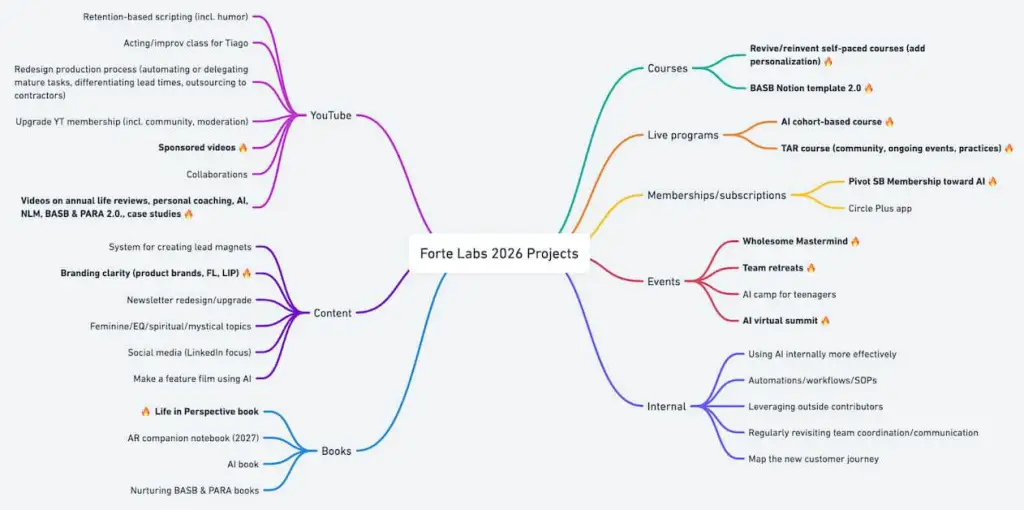
The ones in bold are the ones we plan on pursuing:
- Release v2 of the official Second Brain Notion template – my goal is for anyone seeking to build their Second Brain in Notion to have a useful template as a starting point.
- Launching a new cohort-based course teaching people how to build a Second Brain with AI – my goal is 200 participants, 1 million in revenue, and $500k in profit in the first year.
- Pivot the Second Brain Membership to become AI-centric – my goal is to cover all our fixed and recurring expenses with recurring revenue from it.
- Redesign our self-paced courses to incorporate AI personalization – my goal is to make our courses more effective and impactful for those seeking support.
- Redesign the Forte Labs website – my goal is to modernize our main website and make it the main portal for discoverability of all our content, products, and services.
- Host an AI virtual summit – continuing a tradition from past years, I want to host a free virtual summit bringing together experts on how to use AI for human augmentation and leveraging knowledge.
- Launching my next book Life in Perspective in Nov. 2026 – my goal is 15,000 pre-orders and 100,000 sales in the first 6 months.
- The Annual Review program 2027 – my goal is to make this the best source of guidance and accountability on successfully completing an annual life review, based on the material in my book.
Overall, I’d love to replicate the financial results of this year again next year.
Open questions for 2026
As usual, these are the open questions I’m holding as we begin the new year. If you have any ideas for potential answers let me know!
- What should the community we build around annual life reviews look like?
- How can we reinvent the self-paced course format with AI personalization?
- How should our web presence be organized across Forte Labs, BASB, and the new Life in Perspective book?
- Which direction should we take our BASB app?
- How can we more deeply use AI in our internal workflows and automations?
- How can we create and protect time for open-ended experimentation?
My personal life
New baby
The big news on the family front is…we’re expecting a new daughter, due in early June.
I was going to write a separate post on how and why we decided to have a third child. In a funny way, two kids feels normal, but three seems kind of extreme and almost demands an explanation! But I think it’s actually quite simple: there is nothing in our lives that produces anywhere near as much joy, fulfillment, and meaning as our kids, so why wouldn’t we want another one?
We have the blessing of being able to afford it, not just financially, but because we have large families that can help us. Part of our motivation is ensuring that our children continue to have that same blessing – of multiple siblings – as it’s priceless.
The other major enabling factor is living in Mexico. The slower pace of life centered around community, a kid-friendly culture that welcomes and cherishes them, and of course, our full-time help at affordable prices all make this so much more feasible and natural. We’ve noticed that many, if not most, of the families at our school have three kids, and that’s no accident.
I became a gym rat
My proudest accomplishment in 2025 on the personal front was that I became a gym rat! After spending our first 9 months in Valle complaining about the lack of good exercise options, and suffering through all kinds of aches and pains, I finally found a solution that works exceedingly well.
According to my exercise tracking app, Fitbod (which I love and recommend), I lifted over 500,000 pounds this year, across 52 workouts, mostly in the latter two-thirds of the year. That is definitely the most consistently I’ve ever exercised, and I’m now in the best shape of my life by far.
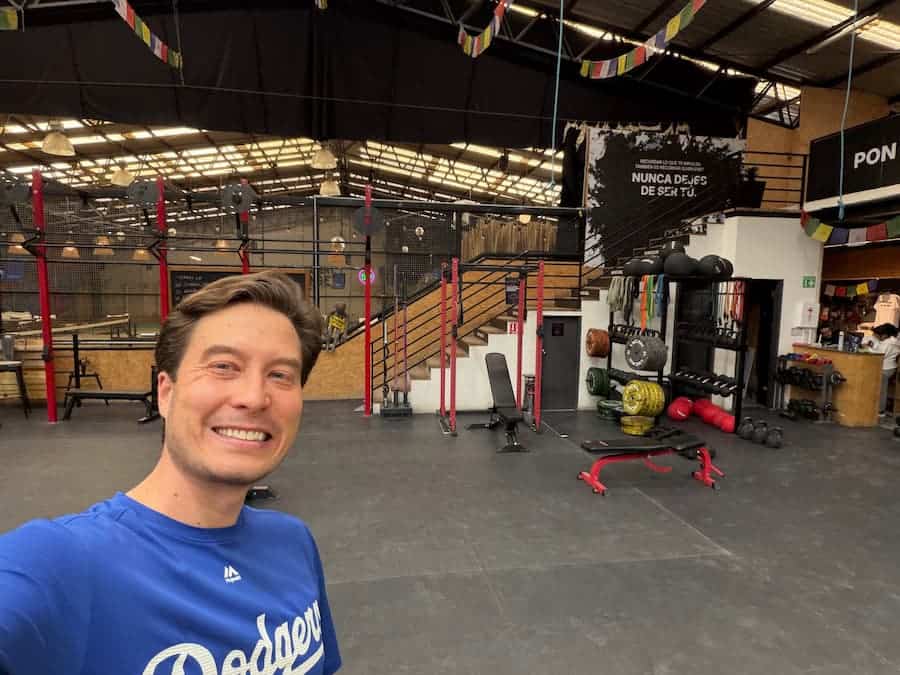
Exercise has been my “white whale” – my biggest unresolved problem – for as long as I can remember. Every year in my review, I identify it as my greatest area of weakness and need. And what I’m surprised by as I look back is just how long it took to find a sustainable answer:
- Finding a nearby gym that was open and empty during the middle of the day when I like to workout (I was surprised to realize how much a full gym discourages me)
- Hiring a nanny who picks up the kids from school and watches them in the afternoons (which I’ve found is the ideal time for me to work out, as a transition from work to family time)
- Buying a second car so that I could work out during the hour that she’s picking up the kids (so I don’t lose out on either work time or time with the kids)
- Downloading a workout app (Fitbod) that generates customized workouts each day for me (this has been so helpful to consistently build strength while also providing variation and rotation)
Besides these practical measures, the background effect of aging as I hit 40 this year provided me with a whole new set of reasons and motivations for staying in shape. I’m in pain now whether I work out or not, so the only choice is whether I want to be in pain from gaining strength, or from losing it. I’ve also been noticing that I can no longer reliably get into deep focus with my work unless I exercise, which provides yet another source of motivation.
At the start of the year, I asked the open question “How can I make irreversible decisions to preserve my willpower?” The best one I found this year ended up being hiring a nanny specifically to watch the kids every day, just so I could exercise. That turned out to be a better source of accountability even than hiring a personal trainer, because once she arrived at the house, I wasn’t about to sit around and do nothing.
When I look in the mirror, I’m amazed to see someone who actually craves going to the gym, who looks forward to lifting heavy weights (of all things). I don’t recognize myself, in other words, and that’s the best feeling in the world. The better physique and strength is just icing on the cake compared to that.
At the same time, 2025 was also the sickest year I can remember. I got bad colds twice, and the flu twice, which meant days at a time in which I was knocked completely offline. I know it was partly due to living in an unfamiliar environment in Mexico, partly from having small children, but the lesson I’m drawing from this is that it’s time for me to take other parts of my health as seriously as I took weight lifting this next year.
Starting to think about Brazil
One of the most amazing phenomena I’ve noticed from doing these reviews for 18 years now is how you can suddenly reach a certain milestone, and a whole new season of your life can suddenly come into view. Like exiting a mountain pass and surveying the vast valley that lies beyond it.
We’ve been living in Valle de Bravo for 18 months now, and all of the sudden I have a sense of how long we’re likely to stay here: another 3.5 years, until the summer of 2029. That will mean 5 years of living here in total, which I think is more than enough for the kids to acquire the language, create a connection with the culture, and for us to all form a true community. It also means we’ll have permanent residency in Mexico by then, and can return anytime.
That horizon, in turn, makes the next stage start to come into view: After Mexico, I want to move straight to Brazil and do the same thing all over again. Seeing how meaningful and fun it’s been for the kids in Mexico, I want them to have the same connection to my family’s homeland so we don’t lose that heritage. I’m thinking a small beach town along the southern coast of Brazil for another 5 years, which will put my oldest at 14 years of age in 2034.
I previously asked the question, “What experiences do I want to have with Caio and Delia over the next 10–15 years, while they’re small?” and the clearest answer I’ve arrived at is adventuring around Latin America.
Built a community
The second proudest accomplishment of the year for me was building a community in Valle. At the start of the year, I asked myself, “What does my jealousy of other people tell me is missing in my life?” and the answer was: I was most jealous of people with deep friendships.
I invested a lot in that area this year, saying yes to almost every invite, finding a group of men who meet every month, and attending many birthday parties with the same families from the school every couple weeks. This is where true satisfaction in life lies: in feeling seen and known and held by a group of people who care about you. I plan on continuing to deepen that aspect of my life in 2026.
The problem of no problem
An interesting thing I noticed during this year’s review that I can’t remember ever feeling is that there was no single, obvious, pressing problem for me to resolve.
Last year, it was the profitability of the business, and we solved that in 2025. In past years, it was exercise, and that’s now also on solid ground. Across the landscape of my work and life, there is no looming threat or urgent crisis demanding my attention.
That is, of course, a tremendous blessing. Much of my 20s and 30s felt like having to work so hard, to build things, to advance and progress – maybe now I get to enjoy the life I’ve built? What a concept!
I have to say that it’s a bit disorienting, to be honest. It’s helpful to have a central issue to orient everything else around, and the lack of one is making me feel uncertain, unmoored, a bit at a loss. I think the main theme of my life is now about savoring and enjoying life, not conquering it, and I’m not completely sure how to go about that.
Suggestions from those who are further ahead on that path are always welcome.
Follow us for the latest updates and insights around productivity and Building a Second Brain on X, Facebook, Instagram, LinkedIn, and YouTube. And if you’re ready to start building your Second Brain, get the book and learn the proven method to organize your digital life and unlock your creative potential.
- Posted in Entrepreneurship, Goals, Personal growth, Self-tracking
- On
- BY Tiago Forte