
By my estimate, less than 1% of the R&D behind my new book, Life in Perspective, made it into the final book. This post is about the rest.
I have a very particular way of writing books.
I see them fundamentally as delivery mechanisms for a method – something you do. And that method can’t just be a nice-sounding idea; it has to be a functional piece of cognitive technology.
I’m talking about CODE, PARA, and now ARC – these are like mental operating systems that get “installed” in a person’s mind through reading. They are written in natural human language instead of computer code, because they are designed to be run on biological brains.
Like any piece of technology, such methods are not born all at once, perfectly formed. They go through a process of R&D, i.e., research & development. They have to be extensively tested in different environments, in different scenarios, and most of all, on different human minds. Only by going through many rounds of iteration can they be considered “proven.”
So what did that R&D process look like for this book? Here’s the short version…
Stage 1: My own 17 years of annual life reviews
The first and most important single source was my 17 years of personal annual life reviews.
All my books come from personal experience. Otherwise, I’m just summarizing the experiences of others. That first-person perspective is what allows me to stand behind my teachings and promise you that they work.
I went through all my past reviews with a fine-toothed comb, looking for any repeating patterns that kept surfacing.
I read my Future Self-Portraits (the culminating exercise in the book), seeing my future continually reshaped through the eyes of my younger self at various ages. I reviewed my gratitude lists, my goals, my retrospectives, my financial reviews, my favorite prompts, and so much more.
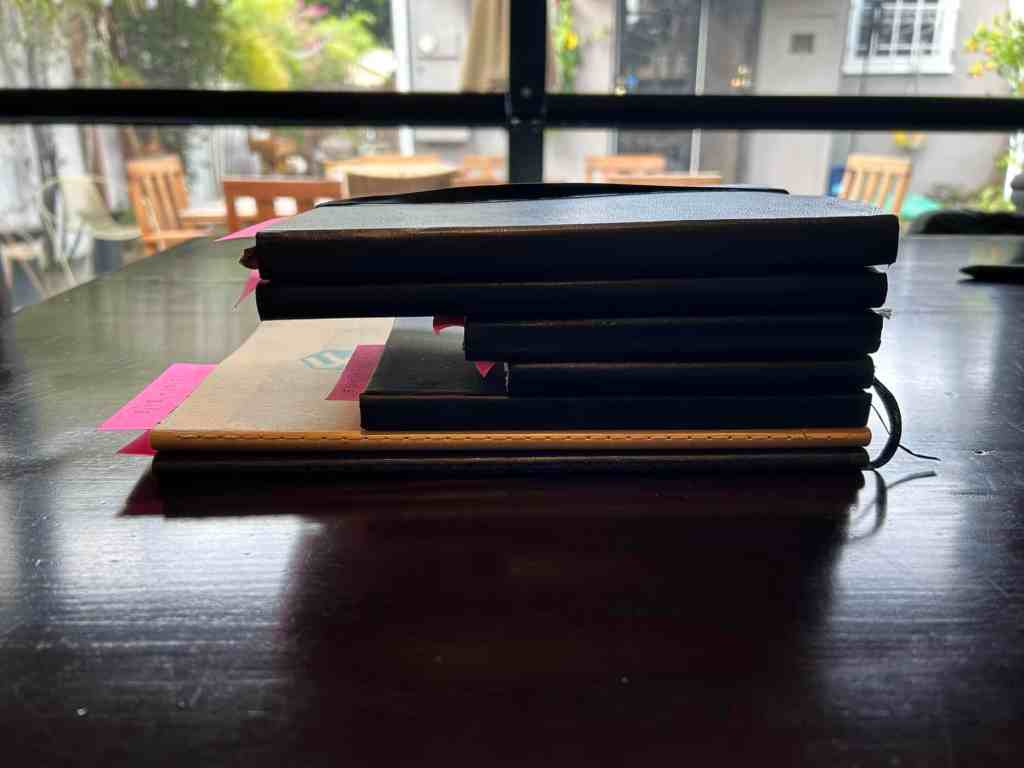
It was remarkable to see the roots of every technique and strategy I advocate for in the book, at almost the very moment it first arose and impacted me, sometime between 2013 and 2023.
Stage 2: Field-testing with students and beta readers
The second stage was field-testing through teaching and coaching.
Across 7 years of delivering our live program The Annual Review®, I stress-tested every element in what would eventually become this book. My team and I tried many dozens of exercises, practices, principles, tools, and guidelines, keeping only the very best ones that reliably produced results for our students.
We gathered tons of feedback, both critical and positive. Including from people who were initially skeptical of the process: “I was initially skeptical… but I found peace with how I spent 2019 and clarity for how I’ll spend 2020.”
We recruited a group of beta readers to go through the first version of the manuscript and provide their comments on what was helpful versus confusing.
Over 500 beta readers left more than 1,000 comments on specific passages throughout the book. I read each and every one, decided whether to act on it, and vastly improved the writing based on all that feedback.
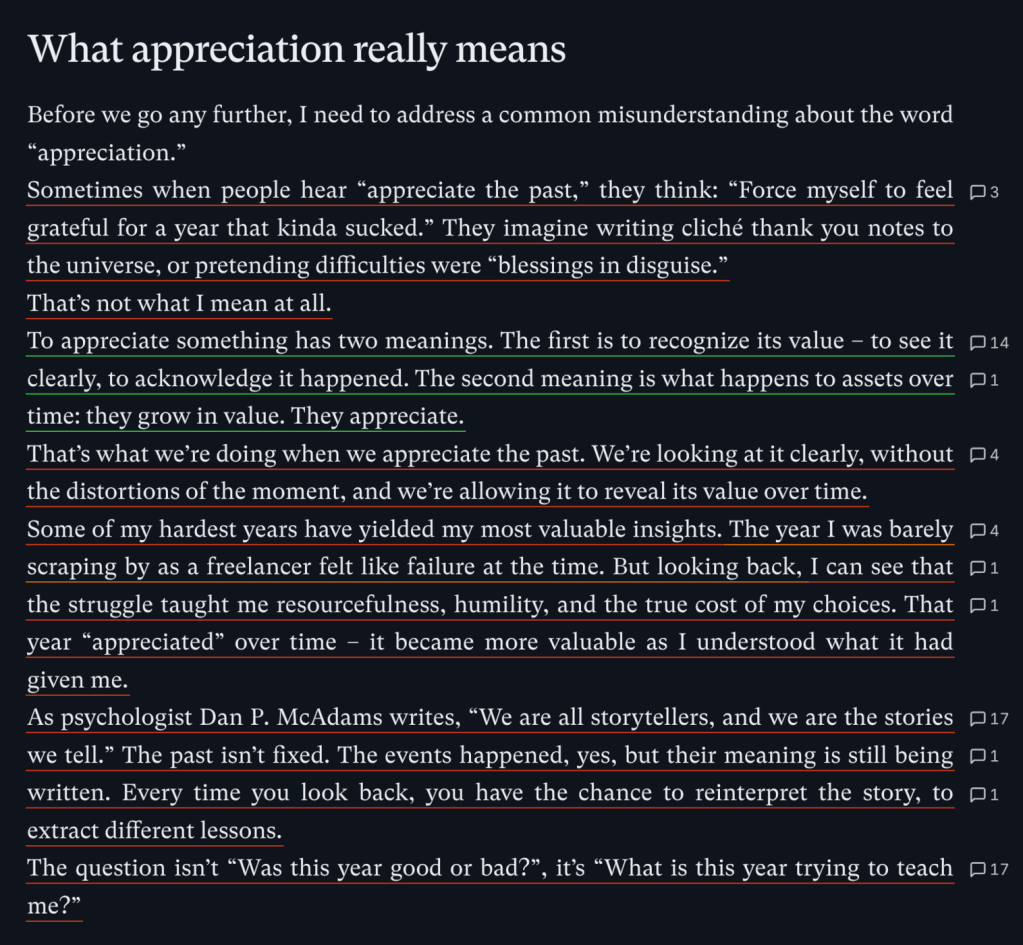
This is why my books are always based on courses – it’s only by teaching the method at the heart of the book, live and in real time, that I can see whether any given part is effective and worth including. Through coaching and helping people work through the obstacles to implementation, I discover what’s missing and how to make it better.
Stage 3: 4,500 years of year-end rituals
The third stage was external research drawn from books, articles, papers, and stories in fields like history, anthropology, religion, and business reporting.
I studied the oldest origins of year-end rituals, such as the 4,500-year-old Babylonian rite of Enuma Elish, in which the king appeared before his people at year’s end to reclaim his fitness for the crown.
I studied where our conception of a year even came from, learning about how the Gregorian Calendar was proclaimed in 1582 but only fully adopted worldwide in the 20th century, finally unifying our fragmented understanding of time into one global standard.
I dove deep into Indigenous rites of renewal, such as those practiced by the Hopi, Mapuche, Balinese, Māori, Haudenosaunee, and Lakota, and realized that every culture has shared a need for a ceremonial passage to “see again.” In the vision quest and the “crying for a vision” it entails, I found a beautiful metaphor for what we’re seeking in modern times.
I mapped the evolution of contemplative traditions in various religions, including the Watch Night, the Peacock Vow, Wesley’s Covenant Renewal, Misogi (“Clean before you plan”), and found the Biblical translation of “metanoia” wasn’t repentance, but reorientation.
I studied the modern history of corporate annual reviews, including the first annual report published in 1602 by the Dutch East India Company, Gallup’s finding that only 14% of professionals find their performance reviews inspiring, and recent innovations such as After-Action Reviews and the Japanese concept of Kaizen, which led to the Agile Movement and most of the software we use today.
Stage 4: The science of how we change
The fourth stage was about scientific research, to ground my teachings in the best of what we know about how the human brain works.
I uncovered the extensive research supporting the “Fresh Start Effect,” that we need to periodically wipe the slate clean and begin again. I read about the End of History Illusion that causes us to mistakenly believe we won’t change much in the future.
I dove into the evidence behind the Theory of Narrative Identity – that we are essentially the stories we tell ourselves, which means we have the ability to edit them. I examined Lisa Feldman Barrett’s surprising findings on “constructed emotion,” that the emotions we feel are interpreted through the language we use to describe them.
I studied the latest advances in goal-setting and was amazed to see the huge gap in effectiveness between process and outcome goals. I learned about infradian cycles and how our bodies and minds are governed by longer time horizons than daily or even monthly ones. And about Attention Restoration Theory and its promise in healing our fragmented attention spans using nature exposure.
Stage 5: Learning from the books that came before
The fifth stage was about studying the existing landscape of books and frameworks around year-end reviews and reflective practice, and related ideas, such as life design.
No book exists in a vacuum, and the best ones, I believe, contribute to the whole existing ecosystem, instead of pretending it doesn’t exist. I see each book I write as an important cause for humanity, and thus I want all the best books in the category to benefit from the conversations I’m creating, rather than seeing them as my enemies.
I looked at Tim Ferriss’s “Past Year Review,” David Allen’s “Horizons of Focus,” Jacqueline Suskin’s A Year in Practice, Michael Hyatt’s Your Best Year Ever, Bonnie Wan’s Life Brief, and Hal Elrod’s Miracle Morning.
I looked at popular templates like YearCompass and the Full Focus Planner. I was somewhat familiar with them already, but I dissected each of these in detail to see what was missing that I could add.
I looked at examples of published year-end reviews by many dozens of different authors, entrepreneurs, artists, musicians, online creators, YouTubers, and others to find the best ideas of what to include, and what not to.
(I curated the most inspiring and moving ones as part of the Annual Review Toolkit that comes along with the book).
Stage 6: Challenging my own assumptions
The sixth stage was about intentionally seeking contrarian inputs.
I want my own assumptions and beliefs challenged as part of this process, so I know I’m not passing along my blind spots to my readers unquestioned.
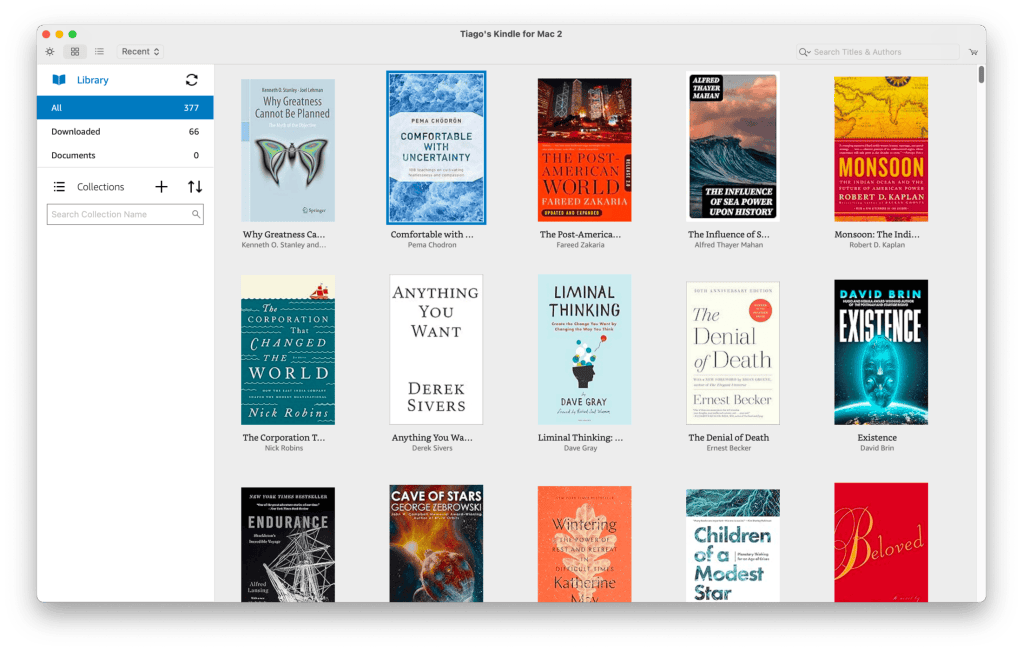
I read the book Why Greatness Cannot Be Planned, which argued persuasively that ambitious lives aren’t reached by optimizing toward fixed goals, and thus challenged my whole understanding of goals.
I immersed myself in the words of writers like Oliver Burkeman, who are challenging the central role of work in our lives. Toyed with profound philosophical ideas such as Bernardo Kastrup’s point that purpose is something that emerges through you, not something you decide yourself.
I entertained some very far-out points of view.
Like Carlo Rovelli’s work in physics indicating that time isn’t real. And Donald Hoffman’s Interface Theory of Perception that argues our minds evolved to help us survive, not understand reality, and thus constantly blind us to the truth.
Stage 7: Bringing in AI, but only at the end
The seventh and final stage is the newest, and involved working with AI to get its feedback, suggestions, and to translate ideas into different forms.
I’ve found that it’s a bad idea to use AI in the initial, foundational stages of the research process when you’re first developing your understanding of the topic. You still have to do the hard thinking and grapple with the best way to understand and formulate each sentence.
But toward the end of the process, AI can be remarkably helpful in polishing and improving the final product:
- To perform quick research surveys on specific concepts, such as “Kairos time,” so I can quickly decide whether they’re worth further investigation
- Keyword spidering, that is, telling me a variety of synonyms or alternative terms for a word, such as “annual review” in this case
- Distilling and exploring large bodies of content; I loaded 6 years of my annual letters into NotebookLM and asked it to identify recurring themes, with specific examples of how they showed up for me across the years
- Transcribing workshops, interviews, voice memos, and content I’d previously created into nuggets of insight so I could decide whether to incorporate them into my book
- Taking on a typical reader’s point of view and giving me feedback about anything that was unclear, confusing, or contradicted something else I said elsewhere
Most of these are things that, without AI, simply wouldn’t happen. They require too much manual, painstaking effort to be worth any human’s time. I believe they made the book much better, without obscuring my authentic voice in the final manuscript.
And that’s it!
Seven stages of R&D, all designed to produce the most effective, distilled, actionable, and impactful product possible – an annual life review that anyone can pick up and follow.
As I said at the start, less than 1% of all the R&D I’ve just described made its way into the final book. And that 1% is delivered through the best delivery mechanism I’ve ever found for truly transformative ideas: a book.

Why a book?
There are so many types of content to choose from these days, and many have questioned the need for books when AI can now (supposedly) explain everything to you instead.
But when it comes to adopting a method that is meant to change your life, I believe that only a book will do, because it’s the only medium that requires layered, spaced repetition.
By sitting with a book again and again, and immersing yourself in the world it’s painting, you allow the ideas to enter your consciousness repeatedly, when you’re in different moods, frames of mind, and environments.
It requires effort and intention, which is part of what makes its arguments sink into the folds of your mind. You’re spending mere hours to consume the effort of years, and that level of distillation is also what makes it enticing – your brain can sense the richness of the knowledge on offer, that immense amounts of careful consideration went into selecting and arranging them for your consumption.
By reading a book and putting its methods to the test, you build up a mental structure that is strong enough to hold up against the raging winds of other people’s opinions, the distractions of the next moment, and the simple passage of time. A structure that has an unmistakable solidity, which comes from the sustained attention it took to build it.
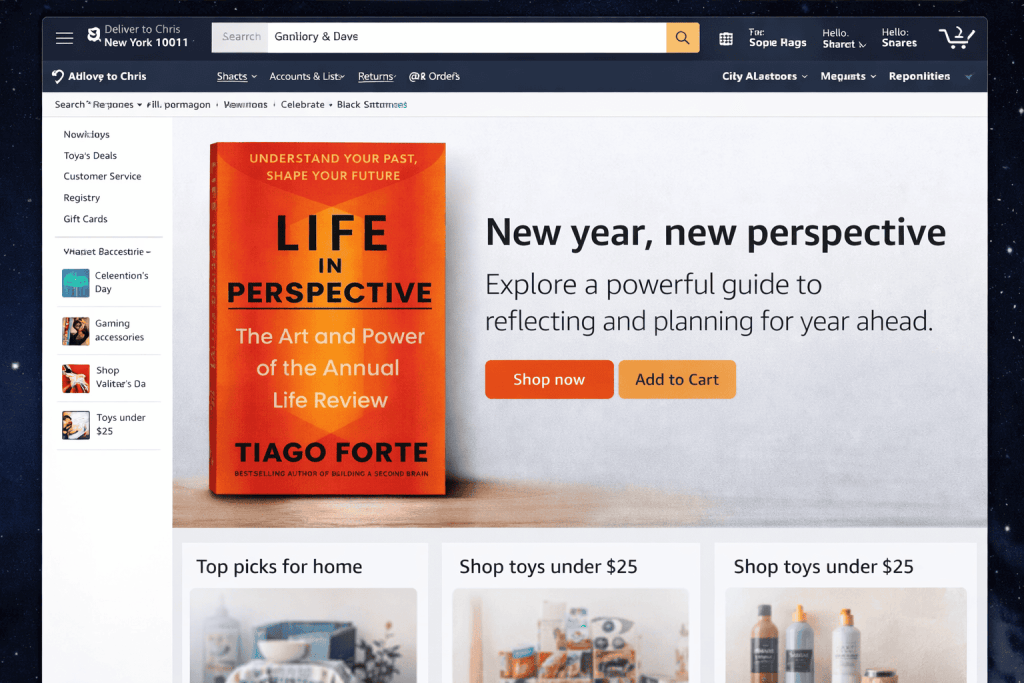
Pick up yours today and get the benefit of all the R&D described above for about $25 or less.
Follow us for the latest updates and insights around productivity and Building a Second Brain on X, Facebook, Instagram, LinkedIn, and YouTube. And if you're ready to start building your Second Brain, get the book and learn the proven method to organize your digital life and unlock your creative potential.