Productivity

The Case for Digital Notes

In our course Building a Second Brain, we teach people how to capture, organize, and share their most valuable knowledge and know-how using technology. We call this practice Personal Knowledge Management, or PKM. One of the most common questions I am asked is “Why digital notes?” This article will explain why, out of all the…

Read More »

You Need a Budget: 13 Parallels Between Money and Productivity

I recently read and took notes on You Need a Budget (YNAB-Affiliate Link), a popular book on personal finance and budgeting (with accompanying software for managing budgets) by Jesse Mecham. My interest in this book is three-fold: I’m terrible at budgeting and need help I want to borrow principles and methods for managing money to help people…

Read More »

The Digital Productivity Pyramid

Imagine if we had a learning curriculum for modern knowledge work. This curriculum would reliably produce elite performers, training them in the fundamental skills required to thrive in the digital age. It would impart concrete skills that could be generalized to any kind of knowledge work, not just one discipline or career path. In our…

Read More »

Case Study: Alex Hardy’s Successful Quest to Conquer Inbox Zero

Just a month ago, I had ~100,000 work-related and personal emails in my inbox. Nearly 60,000 of them were unread. I had haphazard systems of tags, folders, and various inbox extensions to help me manage it. Suffice it to say, my email organization “system” (if you could call it that) wasn’t working. me everytime I…

Read More »

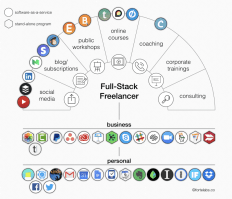
The Rise of the Full-Stack Freelancer, Part II: The Stack

In Part I, I described a new kind of worker called the Full-Stack Freelancer.

I argued that more affordable and user-friendly software-as-a-service (SaaS), among other things, has enabled individuals to manage portfolios of complementary income streams, instead of focusing on only one specialized skill.

But you may have noticed something missing: what is in the

Read More »

The Monthly Review is a Systems Check

In The Weekly Review is an Operating System, I detailed the process I go through each week to capture any new open loops, clear my workspaces, and nail down the events and commitments for the week. In this article, I’d like to do the same for my Monthly Review (MR). Because the MR touches on…

Read More »

The Weekly Review is an Operating System

In his book Getting Things Done, David Allen calls the Weekly Review the “Master Key to GTD.” He claims it is the single most critical habit one must adopt to capture open loops, manage commitments on an ongoing basis, and maintain a “mind like water.” Yet it is also the most difficult habit to maintain….

Read More »

Mood as Extrapolation Engine: Using Emotions to Generate Momentum

I believe that moods (or less colloquially, states of mind) can be used not just defensively, making the best of whatever mood you’re in (as I described in Productivity for Precious Snowflakes). They can also be used offensively, to proactively create the conditions for rapid acceleration and value creation. Let’s begin with a simple question:…

Read More »

Getting Things Done + Personal Knowledge Management

An Integrated Total Life Management System By Tiago Forte of Forte Labs To learn more, check out our online bootcamp on Personal Knowledge Management, Building a Second Brain. One of the key insights of Getting Things Done, the book on personal productivity by David Allen that spawned the worldwide movement known as GTD, was that…

Read More »

The Throughput of Learning

Learning in the 21st century is not about acquiring more information, knowledge, or even insights. The goal is to maximize the throughput of invalidated assumptions. But you have to get there one step at a time. When you first start learning, early in life, there is a bottleneck in the amount of information you have…

Read More »

Bending the Curves of Productivity

Originally published on the Evernote blog To learn more, check out our online bootcamp on Personal Knowledge Management, Building a Second Brain. Consider a typical working session of a couple hours. You set aside the time, silence your phone, and clear your desk, determined to finish some Work of Real Value. We know that time…

Read More »