Organizing

Just-In-Time PM #8: Divergence and Convergence

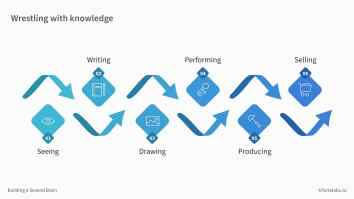
In Part 7, I argued for the importance of interacting with information, instead of just passively consuming it. Interaction results in better learning at the same time as it creates valuable deliverables.

But incorporating all these new ideas about how work is completed – flow cycles and intermediate packets, downscoping and evolving deliverables, interaction over
Read More »

Just-In-Time PM #7: Interaction Over Consumption

In Part 6, I recommended treating any deliverable (whether it’s a simple email all the way to a full-fledged product) as a series of evolutionary artifacts, each one intended to test an assumption or make forward progress.

But there is a deeper reason for downscoping deliverables and then evolving them through a series of stages.

Read More »

Just-In-Time PM #6: Evolving Deliverables

In Part 5, I introduced The Iron Triangle of Project Management and the idea that any given deliverable can be reduced or expanded in scope at any time.

How should you use this newfound ability? You should use it to:

Get started
Maintain momentum
Test assumptions

Read More »

Just-In-Time PM #5: The Iron Triangle

In Part 4, I introduced the idea of “intermediate packets.” Instead of delivering value in a big project that spans huge amounts of time, we want to deliver it in smaller chunks at more frequent intervals.

This follows a basic principle that has revolutionized many industries: small batch sizes.

Read More »

Just-In-Time PM #4: Intermediate Packets

In Part 3, I argued that having a personal knowledge base is the linchpin of success in a creative economy.

A knowledge base allows you to reuse past work, draw from past experiences, share your knowledge in concrete form, and eventually, build products and services out of that knowledge.

This requires strategically structuring your work

Read More »

Just-In-Time PM #3: Flow Cycles

In Part 2, I described the sublime and powerful experience of flow, which could be considered the “holy grail” of productivity.

I argued that there is theoretically no minimum amount of time necessary to get into flow, contrary to popular belief. But in reality, as always, it’s a bit more complicated. Let’s look at what

Read More »

Just-In-Time PM #2: The Fundamentals of Flow

In Part 1, I introduced Return-on-Attention (ROA) as a way to evaluate how we invest our most precious resource – our attention.

But there is a key difference between investing money and investing attention. Units of currency are always uniform and interchangeable. Units of attention, on the other hand, are not at all created equal.

Read More »

Case Study: Alex Hardy’s Successful Quest to Conquer Inbox Zero

Just a month ago, I had ~100,000 work-related and personal emails in my inbox. Nearly 60,000 of them were unread. I had haphazard systems of tags, folders, and various inbox extensions to help me manage it. Suffice it to say, my email organization “system” (if you could call it that) wasn’t working. me everytime I…

Read More »

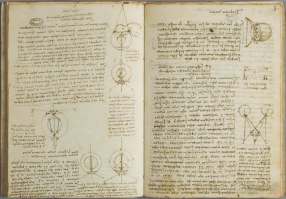
Masters of Creative Note-Taking: Luhmann and Da Vinci

This post also available in Dutch Note-taking is an ancient activity, practiced across cultures, languages, and writing systems for millennia. It is distinct from simply writing things down. For our purposes, note-taking is: Personal, informal, quick and dirty: notes are optimized not for public consumption, but for your own personal use, like a leather notebook…

Read More »