
You’re scrolling LinkedIn during a coffee break. A course creator you know just hit $100K in their first cohort. Another founder you know just closed a funding round. And a peer you met at a workshop got invited to speak at the conference you’ve been attending for years.
“They’re so lucky,” you think, closing the app with a familiar sting of frustration.
But what if luck isn’t what you think it is?
The Runner and the Corner
Every morning at 5:30 a.m., Anne Mahlum ran past a group of homeless men gathered outside the Sunday Breakfast Rescue Mission in Philadelphia. For months, she’d done what most urban runners do — kept her eyes forward, her pace steady, treating them as part of the unchanging landscape of her route.
Then one day, something shifted.
One of the men waved at her. Without thinking, she waved back. The next morning, one called out a joke. She responded with her own.
What started as brief exchanges evolved into genuine rapport. “They would ask me if all I do is run all day,” Mahlum recalls, “and I would ask them if all they do there is stand all day.” These moments of connection sparked an unexpected question during one of her runs:
“Why do I get to be the runner, and these guys get to be the homeless guys on the corner? Why can’t we all be runners?”
Most people would have let that question fade with their footsteps. It would’ve been easy to keep her head down and maintain the distance she’d always kept from them.
But Mahlum noticed something most people missed when they looked at those men: potential.
She invited them to start a running club. Nine men showed up for that first mile. What began as morning runs together eventually grew into Back on My Feet, a nonprofit that now operates in multiple cities, works with 29 homeless shelters, and has helped hundreds of individuals find jobs, housing, and purpose.
Ten years after that first wave, this same ability to see what others couldn’t would earn Mahlum nearly $100 million when she sold [solidcore], the fitness empire she built from a cramped basement studio. When reporters ask her if she had ever imagined such success, Mahlum answers without hesitation:
“Who do you think’s been driving the bus? Of course I did! I know exactly how I got here.”
That kind of certainty wasn’t born overnight. It came from a core belief Mahlum had cultivated for years: that transformation was possible in ways others thought impossible. She had trained herself to see opportunities where others saw nothing.
The Science of Lucky People
Mahlum’s story is an example of what I call “provoked luck” — when small actions create big opportunities that, in hindsight, seem like simple good fortune.
But here’s what researchers now know: luck isn’t chance.
Dr. Richard Wiseman spent over a decade studying why some people feel perpetually “lucky” while others always feel “unlucky.” His research revealed something startling: so-called lucky individuals don’t actually experience more good fortune. They simply see more of it.
Consider one of his most telling experiments. Wiseman asked participants to count photographs in a newspaper. Hidden within the pages was a large, impossible-to-miss message: “Stop counting. There are 43 photos in this newspaper.” Right below it, another message offered $250 to anyone who noticed and reported it to the researchers.
The results were striking. People who identified as “unlucky” typically missed both messages. They were so locked into the counting task that a cash prize in bold print became invisible. Those who considered themselves lucky? They spotted it immediately and claimed the money.
The difference wasn’t intelligence or observational skill. It was attentional bandwidth.
“Lucky” people were looking wider, staying open to the unexpected. “Unlucky” people had narrowed their focus so much that opportunity became literally invisible.
As the scientist Louis Pasteur famously observed, “Chance favors the prepared mind.”
The Three Powers That Create Luck
In my new book Beyond Belief, I introduce a framework for understanding how beliefs shape our reality through three interconnected powers: Attention (what you see), Anticipation (what you feel), and Agency (what you do).
When it comes to luck, all three powers work together to either open or close the doors of opportunity.
Power #1: Attention — What You See
Your beliefs act as perceptual filters, determining what information makes it through to your conscious awareness and what gets dismissed as irrelevant.
Anne Mahlum could have kept running past those men for another ten years. The “opportunity” was there every single morning.
But most people never saw it because their beliefs told them: Homeless people on street corners aren’t opportunities. They’re problems to avoid.
Mahlum’s belief was different. Having grown up with a father who struggled with addiction, she saw potential for transformation rather than permanent circumstances. That belief literally changed what her eyes could see.
Wiseman’s “unlucky” participants weren’t less intelligent or less observant.
They simply had a narrower attentional filter. Their belief — I need to complete this task correctly — made them blind to opportunities right in front of them.
Lucky people train themselves to look wider. They notice the peripheral. They stay curious about the unexpected.
Power #2: Anticipation — What You Feel
But seeing an opportunity is only the first step. You also have to feel confident enough to act on it.
This is where the second power, Anticipation, comes in. Your beliefs about what’s possible shape how you feel about potential opportunities, which in turn determines whether you’ll pursue them.
Consider the limiting belief: “Opportunities only come to certain people.”
If you believe this, you’ll feel discouraged when you spot potential opportunities. That’s probably not for me. I don’t have the right connections. I’m not the type of person who gets breaks like this.
Now consider the liberating belief: “Opportunities are everywhere. I just need to train myself to see them.”
Same opportunity. Completely different emotional response. The second belief generates curiosity, excitement, and confidence. It makes you lean in rather than hold back.
This is the self-fulfilling prophecy in action. Your belief about luck determines how you feel about opportunities, which determines whether you’ll act on them, which determines your actual outcomes.
Unlucky people don’t just miss opportunities. They talk themselves out of pursuing the ones they do see.
Power #3: Agency — What You Do
The final power is Agency: your capacity to take action.
Lucky people don’t just see more opportunities and feel more confident. They also take more shots.
Anne Mahlum showed up at 5:30 a.m. and ran that first mile with nine homeless men. When one program worked, she expanded to multiple cities. When she saw potential in boutique fitness, she opened that cramped basement studio.
Each action created new opportunities. Each small bet compounded.
This is what I call “luck surface area.” The more you engage with the world through visible projects, conversations, and small experiments, the more chances you give luck to find you.
The limiting belief “Some people are just naturally lucky” leads to passivity. If luck is innate, why bother trying?
But the liberating belief “I can create my own luck through how I engage with the world” leads to action. And action creates results that look an awful lot like good fortune.
Your Luck Operating System
If you want to become luckier, you need to upgrade your beliefs. Here are five shifts to make:
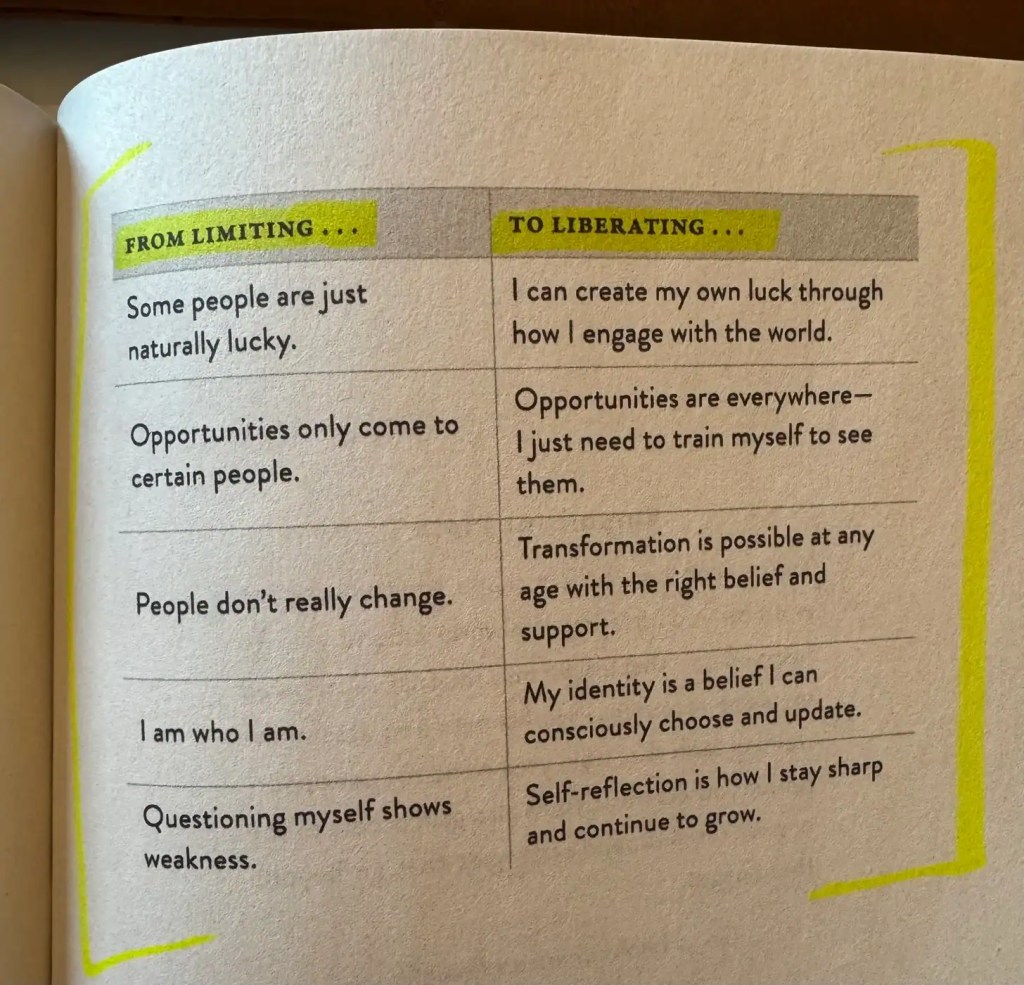
Five Practices to Engineer Your Own Luck
Beliefs are powerful, but they need to be reinforced through practice. Here’s how to build a personal luck system:
- Expand Your Exposure
Be in more rooms. Say yes to more invitations, even when they seem tangential to your current goals. Anne Mahlum didn’t set out to build a fitness empire. She just started waving back.
- Prime Your Attention Daily
Each morning, ask yourself: What opportunities might I overlook today? This simple question shifts your attentional filter from narrow task-focus to broader opportunity-awareness.
- Document Your “Luck Moments”
Keep a running log of coincidences, connections, and unexpected opportunities. Pattern recognition is a trainable skill. When you review these moments (say, during an annual review), you’ll start to see how much of your “luck” was actually created through specific actions and beliefs.
- Lower Your Barrier to “Yes”
Make small experiments ridiculously easy. Can you test an idea in one hour? One day? One conversation? The faster you can move from “interesting possibility” to “actual attempt,” the more surface area you create for luck.
- Build in Public
Share your work, your learning, your questions. Visible projects act like lightning rods for opportunity. Every piece of content you create, every conversation you have, every small project you ship… these all expand your luck surface area exponentially.
Your Challenge
This week, I want you to notice three opportunities you would normally dismiss.
Maybe it’s a LinkedIn connection request from someone outside your industry. Maybe it’s an invitation to an event that seems “not quite relevant.” Maybe it’s a random conversation that your task-focused mind would typically cut short.
Don’t filter them out automatically. Get curious instead.
Ask yourself: What would someone else see in this that I might be missing?
If you don’t change your beliefs about luck, you will miss connections, opportunities, and growth. Not because you’re unlucky, but because you’ve trained yourself not to see.
A year from now, you’ll look back on your life. The question is: how many “lucky breaks” will you have created?
The answer depends entirely on what you choose to believe — and do — starting today.
Nir Eyal is the author of the new book, Beyond Belief: The Science-Backed Way to Stop Limiting Yourself and Achieve Breakthrough Results. A former Stanford lecturer and bestselling author of Hooked and Indistractable, he helps people use behavioral design to build better habits and products. Learn more at nirandfar.com.
Sources:
- Posted in Attention, Cognitive science, Guest Posts, Personal growth
- On
- BY Nir Eyal (Guest Post)